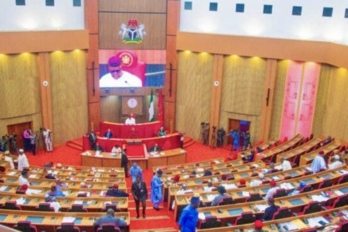
The Nigerian Senate on Tuesday, April 28, 2026, pushed the Nigeria Police Trust Fund Bill, 2026, to second reading, setting off a fresh national argument over how the police should be funded and whether the proposed structure can survive constitutional scrutiny.
The bill seeks to repeal the Nigeria Police Trust Fund Act, 2019 and replace it with a new framework for police equipment, training and welfare, but the chamber’s debate showed that the biggest obstacle is not political noise alone. It is legality.
The sharpest warning came from Senator Ibrahim Dankwambo, who argued that any attempt to retain the controversial 0.5 per cent deduction from the Federation Account could leave the new law vulnerable in court.
He said a similar arrangement had already been challenged before and questioned how a federal police funding law would fit into the wider debate over state police.
Senator Buhari Abdulfatai, on his own part, said the core failure of the system was not only funding, but the absence of the tools, equipment and operational support needed by officers.
Senate President Godswill Akpabio then drew a hard constitutional line, saying, “We make the laws; we cannot also break the laws. The Constitution of Nigeria is the ground norm.”
That warning goes to the heart of the matter. Sections 80 and 81 of the 1999 Constitution require public money to be handled through lawful appropriation and budgetary processes, with withdrawals from the Consolidated Revenue Fund authorised in the manner prescribed by the National Assembly.
In other words, the real question is whether the new trust fund can be built on an automatic statutory deduction, or whether it must pass through the annual estimates and appropriation route that the Constitution demands.
If lawmakers get that balance wrong, the bill may end up carrying the same legal defect that crippled its predecessor.
This is not Nigeria’s first encounter with that problem. In January 2022, the Federal High Court in Abuja ruled that direct deductions from the Federation Account to finance the Nigeria Police Trust Fund were unconstitutional and ordered a refund to Rivers State after it challenged the legality of Sections 4(1)(a) and 4(1)(b) of the 2019 Act.
The ruling made clear that the Federation Account cannot be treated as a limitless cash tap for federal agencies not expressly protected by the Constitution. That judgment remains the legal shadow hanging over the present bill.
President Bola Tinubu had already transmitted a repeal-and-re-enactment bill to the House of Representatives on April 22, saying the overhaul was necessary to improve the management, administration, training, equipment and welfare systems tied to the Police Trust Fund.
His letter also framed the proposed change as a way to strengthen transparency, accountability and long-term sustainability.
The Senate’s action now shows that the executive is pressing for a structural reset, not a cosmetic amendment.
Yet the political record also exposes a worrying inconsistency around the naming and dating of the legislation, which is a small but telling sign that this reform drive is still being assembled under pressure.
There is also a deeper security logic behind the bill. In one detailed report on the same legislative push, the Senate Leader, Opeyemi Bamidele, described the proposal as a move to create a more accountable funding framework with diversified revenue sources, including Federation Account earnings, tax-linked levies, grants, donor support and private sector contributions.
That matters because Nigeria’s insecurity challenge has expanded far beyond ordinary crime into insurgency, banditry, kidnapping, cybercrime and communal violence.
The trust fund is therefore not merely a finance bill. It is being sold as part of a wider attempt to rescue a police system that many believe has been overworked and under-equipped for years.
Still, the political danger is obvious. If the Senate insists on a funding model that looks too close to the one already questioned by the courts, then the new law could become another expensive legal detour.
If, on the other hand, lawmakers redesign the fund so that it is anchored in annual budgetary approval, with tighter audit trails and clearer spending rules, they may yet give the police a more durable financing architecture.
That is why Akpabio’s insistence on constitutional compliance and accountability should not be dismissed as routine rhetoric. It is the only line that can keep this bill alive when the lawyers come in.
The next battleground will be the public hearing. Akpabio has already indicated that the Senate Committee on Police Affairs will be asked to brief the chamber on how previous trust fund allocations were spent, while the hearing itself is expected to test alternative funding options and the bill’s compatibility with any future state-policing structure.
That is where the real story may emerge: whether Nigeria wants a stronger police force, or merely a new legal wrapper around an old funding problem.
In the final analysis, the Senate has done something politically significant but legally unfinished. It has acknowledged that the police need better funding, but it has also reopened the old constitutional trap that made the previous model vulnerable. For now, the bill has advanced. Whether it will survive scrutiny is another matter entirely.
Follow us on our broadcast channels today!
- WhatsApp: https://whatsapp.com/channel/0029VawZ8TbDDmFT1a1Syg46
- Telegram: https://t.me/atlanticpostchannel
- Facebook: https://www.messenger.com/channel/atlanticpostng