By Osaigbovo Okungbowa, Senior Political Correspondent

PORT HARCOURT— Rivers State, once a critical hub in Nigeria’s political landscape, has once again been plunged into chaos following a controversial local government election that has sparked violent confrontations across various local councils. The crisis, which reached a bloody climax on Monday, has raised pressing concerns about governance, security, and the fragile state of democracy in the oil-rich state. Political thuggery, arson, and killings have left a trail of destruction in the wake of a flawed electoral process.
As the dust of violence settles, it is clear that the Rivers State political crisis goes beyond just a disputed election. It reveals deep fissures within the ruling Peoples Democratic Party (PDP) and exposes the heavy toll that political rivalries and manipulations take on the state’s democratic process.
Unfolding of a Violent Crisis
The political crisis reached an alarming crescendo when a series of violent incidents occurred shortly after the Inspector-General of Police (IGP), Kayode Egbetokun, ordered the withdrawal of police officers from local government secretariats. The withdrawal was intended to ensure neutrality and promote the smooth functioning of democratic institutions, but it inadvertently left the premises vulnerable to attacks.
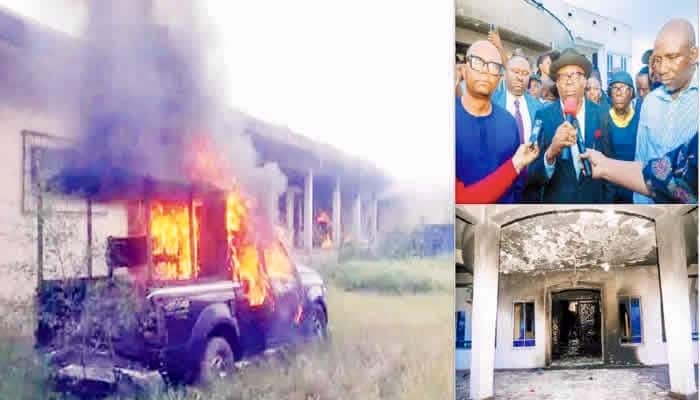
Within hours of the police withdrawal, thugs set fire to Ikwerre Local Government Secretariat, while an explosion rocked the Eleme council secretariat. The unrest quickly spread across other local government areas, including Ahoada East, where gunshots rang out as newly elected council officials attempted to resume work. The violence reportedly left in its wake several dead, including the brother of Edison Ehie, Chief of Staff to Governor Siminalayi Fubara, and the father of a newly elected councillor. Three other unidentified individuals were also killed in the melee.
The violence disrupted the inauguration of the 23 newly elected local government chairmen and 314 councillors, an election whose legitimacy is fiercely contested by opposition parties. In a state already accustomed to political volatility, these events underscore the dangerous nexus between politics and violence in Nigeria, and the broader implications for democratic governance in the country.
The Election Controversy: A Sham or Democratic Victory?
At the heart of the crisis is the contentious local government election held on Saturday, which many political actors—including the state PDP faction loyal to former Governor Nyesom Wike—have rejected outright. The outcome of the election, which saw Governor Fubara’s allies in the Action Peoples Party (APP) declared winners in 22 out of 23 chairmanship positions, has drawn fierce criticism from opposition groups. The APP also won 314 out of the 319 councillorship seats in the 23 Local Government Areas of Rivers State.
This overwhelming victory for Fubara’s allies in the APP has raised suspicions of electoral manipulation. Political observers and opposition parties have questioned the fairness of an election where the ruling party—the PDP—appeared to have lost its grip on local governance. The swift rejection of the poll results by both the PDP and the All Progressives Congress (APC) has only fuelled tensions, with both parties declaring that no election took place in Rivers State on Saturday.
The Rivers State PDP faction loyal to Nyesom Wike described the poll as an exercise in futility, promising to challenge it in court. In their view, Fubara’s administration had no mandate to conduct the election, and the result was nothing short of a political charade. The rejection of the election results has stoked the flames of violence, as rival groups sought to physically prevent the new council chairmen from taking office.
The Fubara-Wike Rift: A Battle for Political Supremacy
The crisis in Rivers State is deeply intertwined with the simmering tensions between Governor Siminalayi Fubara and his political mentor, former Governor Nyesom Wike. Once considered close allies, the two have increasingly found themselves at odds over control of the state’s political machinery. Wike, now the Minister of the Federal Capital Territory, has retained significant influence over Rivers State’s political landscape, particularly within the PDP. His loyalists have been vocal in their opposition to the local government election, seeing it as an affront to their control over the state.
Fubara’s decision to swear in the newly elected council chairmen despite the widespread opposition was a bold move, signalling his determination to assert his authority and break free from Wike’s shadow. However, the governor’s actions have also escalated the political crisis, drawing Wike’s faction into a direct confrontation with his administration. The result has been a sharp polarisation of political forces in Rivers State, with violence erupting as both sides vie for control of local governance.
Political analysts view the Fubara-Wike feud as a proxy war for the 2027 governorship election. With Wike’s future political ambitions still unclear, his loyalists in Rivers State are eager to maintain their grip on power, while Fubara’s camp seeks to consolidate its control. The ongoing violence is symptomatic of this larger struggle, as both factions mobilise their supporters to claim local government seats that are crucial to building grassroots political networks.
A Breakdown of Law and Order
The sudden withdrawal of police personnel from the local government secretariats appears to have emboldened political thugs, who wasted no time in unleashing violence across multiple councils. The police withdrawal was ostensibly a move to restore neutrality, but it has only deepened the crisis, leaving local government facilities vulnerable to attack and creating a vacuum that rival groups have sought to exploit.
In Ahoada East Local Government Area, as the newly elected chairman and councillors attempted to access the secretariat, violence broke out, with gunshots ringing out and protestors clashing. The police were forced to intervene, firing warning shots into the air to disperse the crowd, but the situation soon spiralled out of control. Soldiers eventually took over the secretariat, but not before a relative of the governor’s Chief of Staff, Edison Ehie, was shot dead in the melee.
A similar scene unfolded in Ogba/Egbema/Ndoni Local Government Area, where protesters blocked the council headquarters to prevent the new chairman from taking office. The protesters argued that the Rivers State House of Assembly had extended the tenure of the former council chairman by six months, and that Fubara’s decision to hold an election was unlawful.
These violent confrontations are symptomatic of the wider breakdown of law and order in Rivers State. The inability of the police to maintain control over the situation has raised questions about the role of security agencies in the political crisis. Some critics have accused the police of complicity, suggesting that their withdrawal from the secretariats was part of a broader political scheme to destabilise the state and pave the way for a declaration of emergency rule.
Calls for State of Emergency: A Recipe for Further Chaos?
The violence in Rivers State has prompted calls from some quarters for the declaration of a state of emergency, a move that would effectively suspend the state government and place it under the control of the federal government. However, these calls have been met with fierce resistance from Governor Fubara’s camp, which has dismissed them as politically motivated.
Jerry Omatsogunwa, the governor’s Special Assistant on Electronic Media, was quick to condemn the violence but rejected the notion of emergency rule as “wicked” and “barbaric.” He accused those calling for a state of emergency of engaging in “witchcraft,” arguing that other states experiencing similar levels of violence have not faced such drastic measures.
Omatsogunwa’s comments reflect the deep-seated distrust between the Rivers State government and the federal authorities. Fubara’s administration sees the calls for emergency rule as part of a broader conspiracy to undermine its authority and weaken its political base ahead of future elections. The governor’s camp has urged President Bola Tinubu to ignore these calls, warning that such a move would only exacerbate the crisis and push Rivers State further into chaos.
The Role of the Nigerian Police: Neutrality or Abdication?
The actions of the Nigerian Police Force in the Rivers State crisis have come under intense scrutiny. While the police maintain that their withdrawal from the local government secretariats was in line with directives from the IGP to ensure neutrality, many in the state view the move as a strategic blunder that has contributed to the escalating violence.
The police’s decision to unseal the local government secretariats, which had been closed since July following a crisis over the attempted tenure elongation of former LGA chairmen, was intended to restore normalcy. However, this well-meaning gesture has backfired, as the withdrawal of police protection left the secretariats exposed to attacks by political thugs.
Critics argue that the police should have anticipated the violence that would follow the swearing-in of the new council chairmen, especially given the contentious nature of the election. The lack of adequate security measures in place has raised concerns about the police’s capacity to manage the political situation in Rivers State effectively. Some have even suggested that the police were deliberately complicit in allowing the violence to unfold, a claim the force vehemently denies.
Conclusion: Rivers State on the Brink
The crisis in Rivers State is a stark reminder of the dangers posed by unchecked political rivalries and the fragility of Nigeria’s democratic institutions. What began as a disputed local government election has spiralled into a full-blown political crisis, with violence threatening to destabilise the state. The deaths of several individuals, including the brother of a top government official and the father of a councillor, underscore the human toll of this power struggle.
As the political machinations continue, the people of Rivers State are left to bear the brunt of the chaos. For many, the crisis is yet another chapter in the long history of political violence that has marred the state’s democratic process. The stakes are high, and with no resolution in sight, Rivers State teeters on the edge of anarchy.