- By Atlantic Post Editorial Board
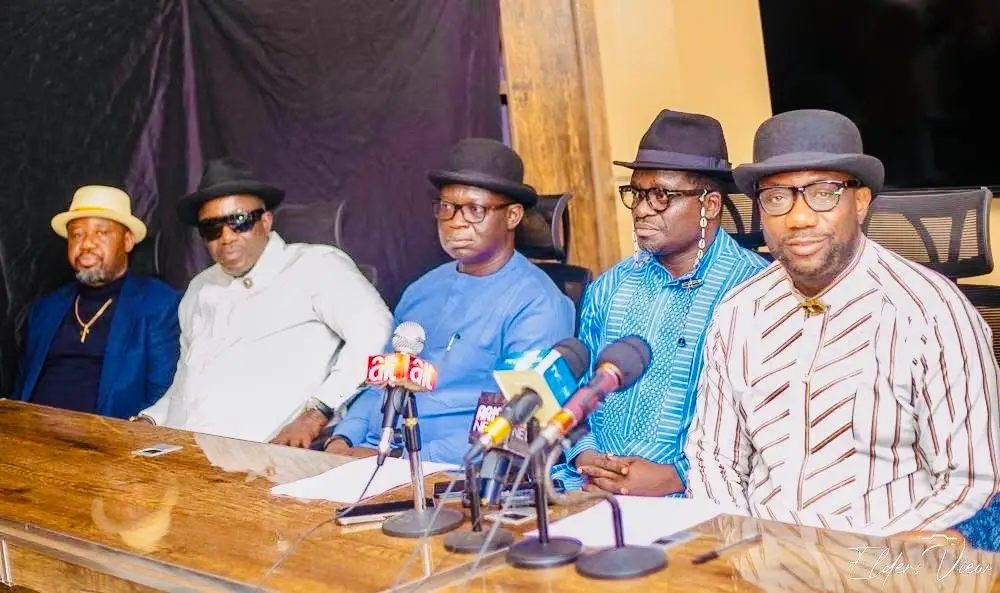
In a dramatic and alarming press briefing that has rocked the corridors of power in Nigeria’s Niger‐Delta, the Ijaw strand of ALGON members in Rivers State has laid bare a dangerous political ploy.
Senior Ijaw leaders have vehemently condemned a series of terror threats—allegedly issued by opportunistic factions within their own community—to not only bolster a belligerent governor, but also intimidate the Rivers State House of Assembly and the Federal Government of Nigeria.
Atlantic Post brings you an in‐depth analysis of this crisis that threatens to undermine national stability and the rule of law.
Mobilisation and Ethnic Loyalty: A Double-Edged Sword
The press briefing began with an assertive declaration from a consortium of Local Government Chairmen and campaign coordinators who, during the last gubernatorial election, rallied the Ijaw vote in key areas including Abua/Odual, Ogu/Bolo, Okrika, Andoni, Asari-Toru, Akuku-Toru, Degema, parts of Port Harcourt, and Ahoada West.
These leaders boasted of their electoral achievements for Governor Siminalayi Fubara, crediting their success to not only organisational acumen but also divine providence.
However, as the briefing unfolded, a more disquieting message emerged. Despite their earlier triumph, these leaders now condemned a series of terror threats that were not only directed at strengthening Governor Fubara’s belligerent position, but strategically aimed at intimidating the Rivers State House of Assembly and the Federal Government.
Such threats are a clear attempt to destabilise the very institutions that hold our democracy together.
Supreme Court Judgement: The Catalyst for Contention
At the heart of the unfolding crisis is a landmark Supreme Court judgement by the Federal Republic of Nigeria.
The judgement, which nullified local government elections tainted by procedural irregularities and reaffirmed the constitutional requirement for the Governor to secure legislative approval before spending state resources, was expected to restore order and promote good governance in Rivers State.
For a brief moment, stakeholders celebrated the decision as a triumph for the rule of law.
Yet, the jubilation was short-lived. The same judgement that should have ushered in a period of stability has instead incited both overt and covert terror threats.
Key Ijaw organisations—such as the Ijaw National Congress and strayed factions of the Ijaw Youth Council—have issued stark warnings: should any attempt be made to impeach Governor Fubara, they would resort to violent measures aimed at critical national oil infrastructure.
However, it is now clear that these threats are not merely about protecting a particular political figure; they are intended to intimidate the Rivers State House of Assembly and the Federal Government, thereby undermining constitutional checks and balances.
A Strategy of Intimidation: Targeting Democratic Institutions
The press briefing underscores a vital point: the Supreme Court’s ruling did not call for the impeachment of Governor Fubara. Yet, in a disturbing twist, the terror threats have been leveraged to create a narrative of a besieged government.
By targeting the Assembly and the Federal Government, these groups hope to deter any attempts at enforcing constitutional provisions, thus giving themselves a free hand to manipulate political outcomes.
This strategy of intimidation is deeply troubling. Rather than facilitating healthy political discourse, it seeks to paralyse the democratic process.
The threats are designed to silence opposition and prevent the Assembly from performing its legislative duties, while also pressurising the Federal Government into inaction.
Such tactics not only erode trust in our democratic institutions but also set a dangerous precedent for political conduct across the nation.
Governor Fubara’s Role: A Question of Leadership
The briefing does not spare Governor Fubara from scrutiny. Although he benefited from a Presidential intervention that shielded him from impeachment, there are serious allegations that his public statements have further fanned the flames of discord.
Instead of employing his influence to calm tensions following the Supreme Court’s decision, the Governor is accused of alluding to plans to mobilise his youthful supporters—actions that could be interpreted as inciting violence.
This raises urgent questions about his leadership. Is Governor Fubara genuinely committed to restoring constitutional order, or is he complicit in nurturing an environment where terror threats become a political tool?
The answer remains murky, but the impact is clear: the use of such threats to intimidate the Assembly and the Federal Government undermines the credibility of his administration and endangers national unity.
Ethnic Identity Misused: The Ijaw Conundrum
Rivers State is a microcosm of Nigeria’s rich ethnic diversity, yet this diversity has become a battleground for political manipulation.
The briefing decries the use of Ijaw identity as a weapon of coercion. Rather than uniting the community, certain factions are using their ethnic identity to justify violent threats and intimidate the nation’s legislative and executive arms.
This misuse of identity is particularly pernicious in a state that is home to multiple ethnic groups. The aggressive rhetoric not only misrepresents the Ijaw people but also risks alienating other communities who have also supported Governor Fubara.
It is a stark reminder that ethnic nationalism, when weaponised for political gain, can lead to the erosion of societal cohesion and provoke further instability.
National Security at Risk: The Economic and Political Fallout
The implications of these terror threats extend far beyond Rivers State. Nigeria’s oil installations—vital to the nation’s economic well-being—are directly threatened by these intimidation tactics.
Any disruption to these critical infrastructures would have catastrophic economic consequences, potentially sparking an energy crisis that could reverberate across the entire country.
Moreover, by targeting the Rivers State House of Assembly and the Federal Government, these threats represent a direct challenge to the core pillars of Nigerian democracy.
The deliberate attempt to subvert constitutional processes through fear and intimidation is not merely a local issue; it is an assault on the nation’s democratic fabric.
A Clarion Call to the Federal Government and Security Agencies
In response to these developments, the press briefing issued a powerful call to action for the Federal Government and national security agencies.
The Police, DSS, Military, and all other relevant bodies must act decisively to protect critical national infrastructure and enforce the Supreme Court’s ruling without compromise.
The threats must be neutralised swiftly and effectively to prevent any erosion of law and order.
It is imperative that the Federal Government does not yield to the pressures of political opportunists but rather stands firm in upholding the constitution.
Any attempt to use terror threats as a bargaining chip to influence political outcomes must be met with the full force of the law.
The Role of Civil Society and Media in Promoting National Unity
Journalists and civic-minded citizens have a duty to expose and condemn these dangerous tactics. The Atlantic Post remains committed to providing incisive, in-depth reportage that holds power to account.
We call on civil society, community leaders, and religious figures to denounce the use of ethnic identity as a tool of political coercion and to promote dialogue over division.
The media must play its part in ensuring that these threats are not allowed to distort the political process.
By shining a light on these underhanded tactics, we can help galvanise public opinion in favour of unity, transparency, and the rule of law.
Moving Forward: Restoring Order and Upholding the Constitution
The crisis in Rivers State is a poignant reminder of the fragility of our democratic institutions. The terror threats, designed to intimidate the Assembly and the Federal Government, must be unequivocally rejected.
It is high time for all stakeholders—political leaders, security agencies, civil society, and the media—to unite in defence of the nation’s constitutional order.
Governor Fubara and his administration must demonstrate a commitment to democratic principles by distancing themselves from any rhetoric that could incite further violence.
At the same time, the Federal Government must ensure that the Supreme Court’s ruling is implemented fully and fairly, without yielding to the pressures of ethnic or partisan interests.
Conclusion: A Plea for National Unity
The press briefing by the Ijaw strand of ALGON members is both an exposé and a dire warning. The deliberate use of terror threats to intimidate the Rivers State House of Assembly and the Federal Government is a strategy that threatens the very essence of our national unity.
Ethnic identity should serve as a bridge, not a barrier, to political progress.
It is incumbent upon all Nigerians to reject the divisive tactics of a few and work collectively towards a future where the rule of law prevails.
Call to Action:
- For the Federal Government: Act decisively to protect critical infrastructure and enforce the Supreme Court’s judgement, ensuring that terror threats are met with swift legal action.
- For Governor Fubara and Political Leaders: Renounce incendiary rhetoric and commit to a governance model rooted in dialogue and constitutional respect.
- For Security Agencies: Prioritise the safety of the Rivers State House of Assembly and Federal institutions by deploying all necessary measures to counteract intimidation tactics.
- For Civil Society and Media: Continue to expose and condemn any attempt to manipulate ethnic identity for political gain, and promote narratives that foster unity and peace.
- For the Citizens of Nigeria: Reject the allure of divisive politics and stand together in support of a democratic, inclusive, and stable nation.
The future of Rivers State—and indeed, Nigeria—hinges on our collective ability to rise above ethnic divisions and safeguard our constitutional institutions.
Let us unite in the spirit of peace and democracy, ensuring that our nation’s progress is not derailed by the destructive forces of terror and intimidation.
- An Atlantic Post Editorial Opinion