By Editor
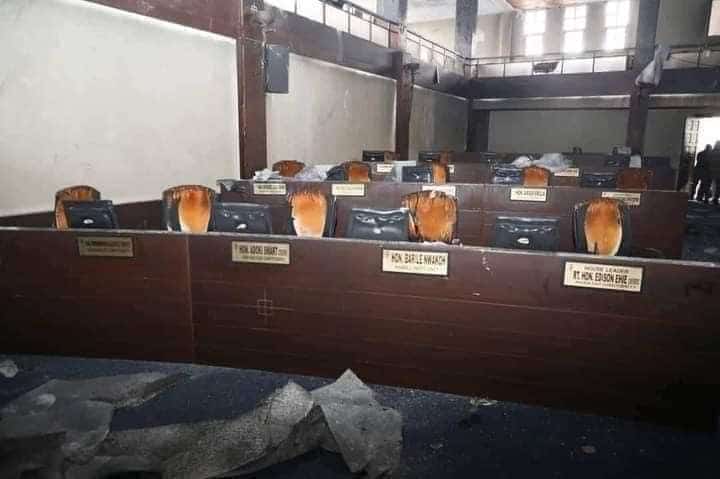
PORT HARCOURT — The political landscape of Rivers State remains ablaze with tension, controversy, and unanswered questions nearly a year after the devastating arson attack on the Rivers State House of Assembly. The symbolic seat of democracy was set alight in a brazen act that shook the state to its core, leaving a trail of anger, fear, and frustration among its citizens. Yet, despite the gravity of this attack, Governor Siminalayi Fubara’s response, or rather, his deafening silence, has raised eyebrows and spurred heated debate across the state.


Martins Wachukwu, a well-known political commentator, has vocalised what many in the state are already thinking: Why has Governor Fubara not set up a Judicial Commission of Inquiry to investigate the October 29, 2023, arson? In contrast to his swift action in establishing a commission to investigate the burning of Local Government Secretariats, the Governor’s inaction on the Assembly fire has sparked widespread suspicion that political interests may be at play. Wachukwu’s piercing question resonates across the state: Why has Governor Fubara delayed bringing the perpetrators of this heinous act to justice?
In this exposé, we delve into the heart of this unfolding political drama, analysing the implications of the Governor’s actions, or lack thereof, and critically examining the mounting pressure from the people of Rivers State for answers. Is this simply a case of delayed justice, or is there more beneath the surface of Rivers State politics?
A Year of Silence: Has Justice Been Delayed or Denied?
The House of Assembly is more than just a physical structure; it is the heart of Rivers State’s democracy, where elected representatives debate, deliberate, and make decisions that shape the future of the state. The burning of the Assembly on that fateful day in October was not just an attack on a building but an assault on the very essence of democracy in Rivers State. The symbolism of the fire, reducing the legislative chamber to ashes, was a direct attack on the people’s will, a chilling reminder that political violence in Nigeria can rear its ugly head at any moment.
For nearly a year, the people of Rivers State have waited with bated breath, hoping for Governor Fubara to take decisive action by setting up a Judicial Commission of Inquiry to investigate the fire. However, instead of swift action, what they have received is silence—silence that has now morphed into suspicion.
Martins Wachukwu, in his scathing commentary, articulates what many have already been murmuring: the failure to investigate the fire suggests a deliberate effort to sweep the incident under the carpet. The prolonged delay raises serious concerns about whether certain political interests are being protected and whether the perpetrators of the arson are being shielded from justice.
Wachukwu asks the critical question that sits at the heart of this issue: If Governor Fubara could so quickly set up a commission to investigate the burning of Local Government Secretariats, why has he not done the same for the House of Assembly fire, which carries far more significant democratic implications?
The Contradiction: Speedy Action for Local Government Arson vs. Assembly Fire Silence
Governor Fubara’s recent decision to empanel a Judicial Commission of Inquiry to investigate the burning of several Local Government Secretariats in Rivers State only serves to exacerbate the controversy surrounding his inaction on the Assembly fire. Just days ago, the Governor swiftly established the commission, tasked with investigating the local government incidents that occurred following a contentious local election and swearing-in ceremony. The promptness of this response stands in stark contrast to his almost year-long inaction on the House of Assembly fire.
This glaring contradiction has not gone unnoticed by political stakeholders, civil society organisations, and the general public. If the Governor can act with such alacrity to investigate the destruction of local government facilities, why has he failed to act with equal urgency to address the arson attack on the state’s most important democratic institution?
Many argue that this selective action is indicative of a deeper political motive. By quickly addressing the local government incidents, Governor Fubara may be attempting to maintain control over local political structures that are more directly tied to the ruling political party’s grassroots base. However, the House of Assembly, with its broader and more complex political implications, may involve interests that the Governor is determined to silence.
Wachukwu’s assertion that the bulldozing of the entire Assembly building following the fire could be an attempt to “conceal the bizarre act” further fuels speculation that the Governor’s inaction is not merely bureaucratic delay but a calculated political strategy. The removal of the physical evidence—the burnt Assembly chamber—raises even more questions about the Governor’s commitment to transparency and justice.
Political Undertones: Is Governor Fubara Shielding Political Allies?
One of the most damning allegations circulating within Rivers State is that the Governor’s silence is part of a broader scheme to protect powerful political figures who may have been involved in or benefitted from the arson. While no concrete evidence has emerged to substantiate these claims, the perception of political interference in the investigation process has gained traction, particularly as the months have dragged on without any meaningful action from the Governor’s office.
Wachukwu’s commentary strikes at the heart of this suspicion, pointing out the growing belief among citizens that “the delayed response is seen by many as an attempt to shield some political interest from prosecution.” The political undertones of this statement are hard to ignore, as they reflect the widespread sentiment that justice is being deliberately stalled for political reasons.
Governor Fubara, a member of the ruling People’s Democratic Party (PDP), has been accused of using his office to protect political allies who may have had a hand in the Assembly fire. While these accusations remain speculative, they are not without precedent in Nigerian politics, where political violence and arson have historically been employed as tools of intimidation and control.
The question now is whether the Governor will heed the growing calls for a thorough and transparent investigation or whether he will continue to stonewall efforts to uncover the truth.
The People’s Call for Justice: Will Governor Fubara Act?
As the one-year anniversary of the Assembly fire approaches, the people of Rivers State are growing increasingly impatient. Civil society groups, political stakeholders, and everyday citizens are demanding answers. They want to know who was responsible for the arson, what motivated the attack, and why those responsible have not yet been brought to justice.
Wachukwu’s commentary captures the urgency of these demands, noting that “the people of Rivers State are hoping that Governor Fubara will take urgent steps in setting up a Judicial Commission of Inquiry to investigate the Assembly fire.” Such a move, he argues, would demonstrate the Governor’s commitment to upholding the rule of law and ensuring that justice is served.
However, the question remains: will Governor Fubara act? Or will he continue to ignore the growing chorus of voices demanding justice?
A Political Ticking Time Bomb: The Consequences of Inaction
Governor Fubara’s continued inaction on the Assembly fire could have serious political consequences. As Wachukwu astutely observes, “the people of Rivers State are watching closely and will not rest until justice is served.” This statement underscores the growing sense of frustration and anger among the people of the state.
If Governor Fubara fails to act, he risks alienating a significant portion of the electorate who see his inaction as a betrayal of their trust. Moreover, his silence on the issue could embolden political rivals and opposition parties, who may use the Assembly fire as a rallying point to challenge his leadership in future elections.
The political stakes are high, and Governor Fubara’s decision—whether to act or remain silent—will have far-reaching implications for the future of Rivers State politics.
Conclusion: A Test of Leadership
In the final analysis, the October 2023 House of Assembly fire has become a litmus test for Governor Fubara’s leadership. His response, or lack thereof, to this crisis will define his legacy as a leader. Will he rise to the occasion and demonstrate his commitment to justice and the rule of law, or will he succumb to the political pressures that have thus far kept him silent?
As Wachukwu aptly notes, “only time will tell if Governor Fubara will respond to the mounting pressure or if this seeming inaction is fuelled by political manoeuvring.” One thing is certain: the people of Rivers State will not rest until justice is served. Whether that justice comes from Governor Fubara or from other quarters remains to be seen.