An explosive in-depth report on the Lagos State House of Assembly leadership crisis, examining Speaker Mudashiru Obasa’s re-election, the contentious clerk reinstatement battle, and the political intrigue gripping Nigerian governance.
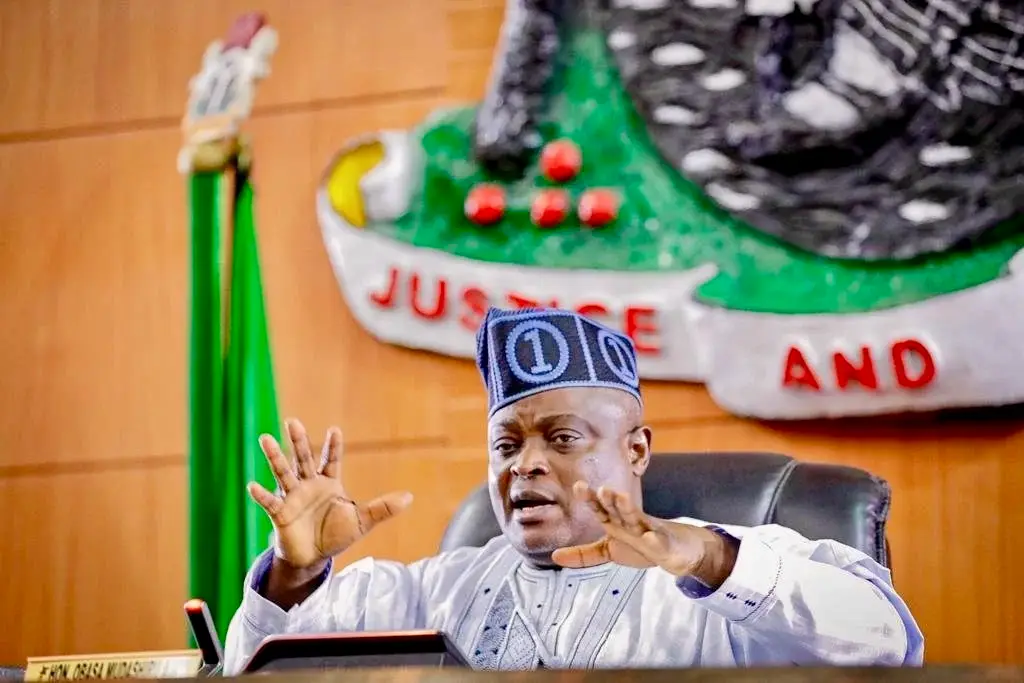
IKEJA, Lagos — In an atmosphere charged with tension and simmering discontent, the Lagos State House of Assembly finds itself at the epicentre of a political maelstrom following the dramatic re-election of Mudashiru Obasa as Speaker.
The latest developments—sparked by a hastily convened meeting at the Assembly complex in Alausa, Ikeja—have unearthed a deep-seated rift among lawmakers, with fresh debates ignited over the contentious issue of the Clerk’s reinstatement.
At the heart of this political saga is a leadership crisis that has rocked the institution, leaving many to question the integrity and decision-making of the legislators.
Obasa, whose return to the Speaker’s chair was marked by a series of high-level interventions from influential members of the All Progressives Congress (APC), notably former governors Baba Bisi Akande and Aremo Olusegun Osoba, is now facing a fierce backlash from his colleagues.
The underlying tensions, exacerbated by long-standing grievances and procedural missteps, threaten to undermine the credibility of the House at a time when effective governance is most needed.
The Turbulent Timeline: From Leadership Crisis to Reinstatement
The current controversy can be traced back to a dramatic sequence of events earlier this week. On Monday, the Assembly experienced an unexpected turn of events when Mojisola Meranda, then incumbent Speaker, tendered her resignation amidst mounting pressure and internal dissent.
Meranda, who had only been at the helm for a brief 49-day tenure, was subsequently re-elected as Deputy Speaker—a post she had held prior to her brief ascension to the Speakership on January 13, 2025. This rapid reversal set the stage for a high-stakes political showdown.
Following Meranda’s resignation, Obasa was reinstalled as Speaker in a polarising 40-member vote that underscored the deep divisions within the legislative body.
The intervention by senior APC figures, determined to restore a semblance of order, played a pivotal role in orchestrating Obasa’s return.
However, his re-election did little to placate the simmering discontent among several lawmakers who viewed the move as both abrupt and unrepresentative of the House’s collective will.
A Meeting That Uncovered More Than Reconciliation
In what was billed as a conciliatory effort, Obasa convened a meeting on Tuesday with his fellow legislators in an attempt to mend the fractured relationships within the House. Yet, rather than fostering unity, the gathering only served to amplify the existing tensions.
According to accounts from lawmakers—some of whom preferred to remain anonymous—the meeting quickly descended into an arena for airing grievances rather than a platform for reconciliation.
One lawmaker remarked critically on the meeting’s management:
“First, one of the issues we raised as a reason for his removal happened again. A meeting scheduled for 1pm did not hold until 2.30pm. We were all kept waiting and when he arrived, there was no apology for the late commencement of the meeting.”
This pointed lack of courtesy, coupled with an apparent dismissal of the members’ concerns, left many feeling sidelined. The meeting’s agenda, which was reportedly dominated by the contentious issue of the suspended Clerk, Olalekan Onafeko’s reinstatement, overshadowed any attempts at genuine dialogue.
The Clerk Conundrum: A Battle for Institutional Integrity
At the centre of the latest uproar is the fraught debate over the reinstatement of the Clerk of the House. Suspended on January 13—the same day that saw Obasa’s abrupt removal—Onafeko’s dismissal has now taken on a life of its own.
In a dramatic twist, while his successor Ottun Babatunde assumed the duties of the Clerk during Monday’s plenary, Onafeko has mounted a legal challenge, dragging both Babatunde and the Assembly to the National Industrial Court.
His battle is emblematic of a broader struggle over institutional integrity and the politicisation of key administrative positions.
Obasa’s recent push for the reinstatement of Onafeko is seen by many as a tactical move to consolidate support and restore what he perceives as rightful order. A source close to Obasa revealed,
“Obasa is pushing for Onafeko to return but the lawmakers are adamant. Although some of them are already shifting ground and considering. Let’s see how it goes.”
This internal discord highlights a significant schism: while the Speaker’s camp appears to be rallying behind a return to previous administrative norms, a faction of lawmakers remains steadfast in their opposition—citing both the procedural irregularities of the clerk’s suspension and the broader implications for the legislative body’s independence.
Political Intrigue and the Shadow of the DSS
The controversy is further compounded by reports that the suspended Clerk’s case has not been contained within the civil sphere. The involvement of the Department of State Services (DSS) has added a layer of complexity and alarm to an already volatile situation.
One lawmaker lamented that what should have been a routine civil matter has escalated into a politically charged incident with far-reaching implications.
The attendant arrests of some colleagues only deepened suspicions of ulterior political manoeuvring, suggesting that the crisis might be as much about power consolidation as it is about administrative redress.
Such developments underscore the potential risks when political interests override institutional propriety.
In the midst of this chaos, many lawmakers are left wondering if the current leadership can truly steer the House towards stability, or if the internal divisions will further erode public confidence in the legislative process.
The Legacy of Leadership and the Road Ahead
For a body as storied and influential as the Lagos State House of Assembly, the current crisis represents not only a test of leadership but also a reflection of the broader challenges facing Nigerian governance.
With decades of political history and institutional memory at stake, the reverberations of this discord are likely to be felt far beyond the walls of the Assembly complex.
Critics argue that the rapid shifts in leadership—exemplified by Meranda’s short-lived tenure and the subsequent reinstallation of Obasa—have left the institution vulnerable to external influences and internal betrayals.
The involvement of heavyweight political figures such as Baba Bisi Akande and Aremo Olusegun Osoba in the manoeuvring around the Speaker’s chair further complicates the narrative.
Their intervention, while aimed at restoring order, has inadvertently highlighted the extent to which political patronage and personal loyalties continue to influence legislative affairs.
Indeed, the fallout from this crisis raises poignant questions about the future direction of the House.
Can it maintain its autonomy in the face of relentless political pressure?
Or will the persistent infighting and factional disputes render it a puppet of higher political powers?
These questions remain unanswered as the crisis deepens and the assembly braces itself for further legal and political battles.
The Legal Battle and Its Implications
As the National Industrial Court prepares to hear the case brought by the suspended clerk, the outcome is being keenly watched by political analysts and legal experts alike.
The court’s decision could set a significant precedent, influencing not only the internal dynamics of the Lagos State House of Assembly but also the wider framework of administrative justice in Nigeria.
For many, this is more than a mere personnel dispute—it is a litmus test of the rule of law and the capacity of political institutions to resolve conflicts without succumbing to partisan interests.
Onafeko, speaking candidly to the media, encapsulated the gravity of the situation:
“Sometimes, you manage the situation. That doesn’t mean you don’t know what you’re doing, but for the sake of peace and the integrity of the institution itself, and I want to defer to the members of the House. I know that they will do the right thing. So, let’s take it one step at a time.”
His measured stance, emphasising the need for both legal and political resolution, is a clarion call for moderation in what has become an increasingly acrimonious dispute.
Yet, his call for calm appears to fall on deaf ears in an environment where personal ambition and political expediency continue to reign supreme.
Conclusion: A House Divided and the Call for Reforms
As the Lagos State House of Assembly stands at this critical juncture, the need for a comprehensive reassessment of its governance structures has never been more urgent.
The recent episode is symptomatic of deeper systemic issues—issues that threaten to erode the very foundations of democratic accountability and legislative independence.
The stark divisions within the House, laid bare by the recent meeting and the ensuing public outcry, serve as a grim reminder that political expediency must never trump institutional integrity.
For Speaker Mudashiru Obasa, the path ahead is fraught with challenges. His bold initiative to reinstate the beleaguered clerk, Olalekan Onafeko, is but one battleground in a larger struggle to reclaim the honour and autonomy of the Assembly.
With legal proceedings set to resume and tensions still running high, all eyes remain on Lagos as this saga unfolds.
In the coming days, the actions of both the Speaker and his detractors will determine whether the Assembly can emerge from this crisis as a unified, effective body—or if the current strife will pave the way for further divisions and a legacy of discord.
In a political landscape already marred by historical grievances and power struggles, the current developments in Lagos are a clarion call for introspection and reform.
Only time will tell if the leaders within the House can bridge the deep ideological chasms that have divided them, or if this latest chapter will mark yet another turning point in the turbulent history of Nigerian politics.
As the drama continues to unfold, stakeholders and observers alike are left to ponder the future of one of Nigeria’s most influential legislative bodies.
The fate of the Clerk’s reinstatement, the legal battles looming on the horizon, and the broader implications for democratic governance in Lagos remain uncertain—and undeniably explosive.
This is Atlantic Post’s exclusive in-depth investigation into the heart of Nigeria’s political crisis, where every decision and every dissent is a testament to the enduring struggle for power and principle in our nation.
- Additional report by Osaigbovo Okungbowa, Atlantic Post Senior Political Correspondent