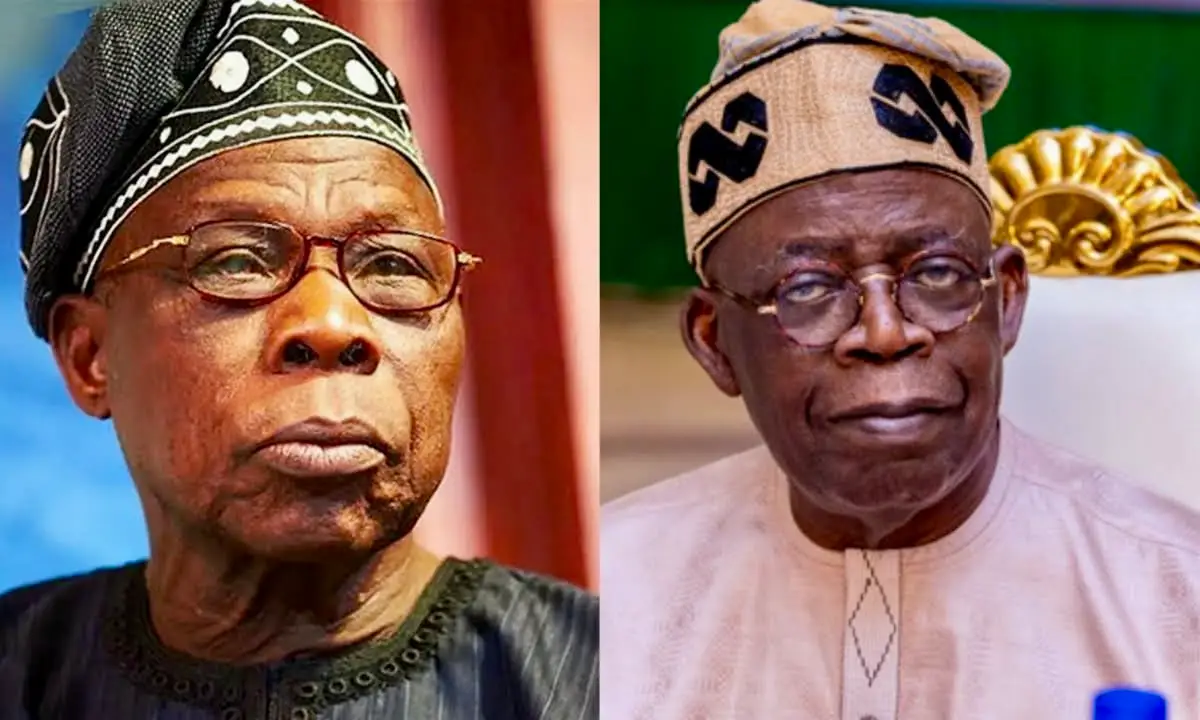
Former President Olusegun Obasanjo sharply criticises President Bola Tinubu’s administration in his new book, condemning the N15.6 trillion Lagos-Calabar Highway and N21 billion VP residence projects as symbols of corruption and mismanagement. He advocates for systemic reform, including a shift to “Afrodemocracy,” as Nigeria grapples with widespread public disillusionment.
In a blistering new chapter of his latest book, Nigeria: Past and Future, former President Olusegun Obasanjo has pulled no punches in his critique of President Bola Tinubu’s administration. Speaking at his 88th birthday celebration, Obasanjo condemned two of the government’s flagship projects – the N15.6 trillion Lagos-Calabar Coastal Highway and the N21 billion official residence for Vice President Kashim Shettima – as paradigms of wasteful spending and systemic corruption.
Let us delve into Obasanjo’s incendiary assertions and explore the wider implications for Nigeria’s governance and development trajectory.
A Highway to Nowhere?
Obasanjo’s revelations in his latest book, Nigeria: Past and Future, have sent shockwaves through the political establishment. In Chapter Six, he lays bare his disgust at what he perceives as the deliberate misallocation of national resources.
The Lagos-Calabar Highway, spanning 700 kilometres at a staggering estimated cost of N4.93 billion per kilometre, is being constructed on a counterpart-funding basis.
However, the allocation of approximately N1.06 trillion – merely six per cent of the overall budget – for the pilot phase, stretching from Eko Atlantic to Lekki Deep Sea Port, has raised more than a few eyebrows.
Critics argue that this mega-project, now valued at N15.6 trillion upon completion, is emblematic of a broader malaise that has long plagued Nigerian infrastructural endeavours.
Obasanjo’s commentary is not merely a cursory observation but a damning indictment of a system he believes is inherently rigged against the interests of the nation.
His rhetoric, notably captured in the phrase “it is my turn to chop,” underscores a transactional political culture where public office is nothing more than a conduit for personal enrichment.
For a nation struggling under the weight of poverty and underdevelopment, such extravagant projects appear as little more than a charade designed to mask deeper systemic issues.
The VP Residence: A Misplaced Priority
Not stopping at the highway, Obasanjo’s tirade extends to the N21 billion new official residence for Vice President Kashim Shettima. In a time when many Nigerians continue to grapple with economic hardship, the decision to invest such colossal sums on a luxury domicile is seen by many as both tone-deaf and emblematic of misplaced priorities.
According to Obasanjo, the VP residence project is “a conduit designed to embezzle public funds” – an accusation that cuts to the very heart of Nigeria’s recurrent corruption challenges.
This lavish spending, he argues, is not an isolated miscalculation but rather a symptom of a deeply entrenched political culture.
The former President’s harsh words echo the frustrations of countless citizens who have witnessed their tax money diverted from critical sectors such as healthcare, education, and infrastructure.
By choosing opulence over necessity, the administration risks further alienating a populace that is increasingly disillusioned by what many see as an indifferent political elite.
Awarding Contracts and the Question of Transparency
One of the most contentious aspects of the Lagos-Calabar Highway project is the opaque manner in which the contract was awarded. Obasanjo’s book points a critical finger at the decision to grant the contract to Gilbert Chagoury’s Hitech Construction Company without a competitive bidding process.
Chagoury, a long-standing business associate of President Tinubu, now finds himself at the centre of a maelstrom of accusations regarding preferential treatment and corruption.
Prominent figures, including former Vice President Atiku Abubakar, have openly questioned the integrity of awarding such high-stakes contracts without a transparent competitive process.
This practice of sidelining competitive bidding undermines public trust and reinforces the narrative of a ‘corrupt system’.
With over 230 million Nigerians expected to bear the brunt of these decisions, the lack of accountability is not only alarming but also a stark reminder of the need for systemic reform.
The controversies surrounding the contract award have ignited fierce debates on social media and in political circles, with many calling for a thorough investigation into the processes that led to this multi-trillion naira expenditure.
A Broader Critique of Nigeria’s Leadership
Obasanjo’s blistering attack is not limited to the specifics of the highway or the VP residence; it is a sweeping critique of a political class that he claims is fundamentally ill-prepared to lead.
In his book, he contends that many who hold power – from governors to local government chairmen – are more interested in enriching themselves and their cronies than in delivering meaningful development for the nation.
“State resources are captured and appropriated to themselves with a pittance to staff and associates,” he asserts, pointing to a pattern of corruption that has left Nigeria mired in poverty and underdevelopment.
This systemic malpractice, as Obasanjo notes, is compounded by a worrying trend where political aspirants are willing to incur massive debts before elections, confident that they will soon have access to public funds to settle these obligations.
Such behaviours, he argues, reflect a governance model where personal gain trumps public service, and the nation’s welfare is sacrificed at the altar of self-interest.
Enter Afrodemocracy: A Radical Reappraisal
In a provocative twist, Obasanjo does not merely criticise the status quo – he offers a radical alternative. He contends that Western liberal democracy, as practised in Nigeria, is inherently ill-suited to the African context.
Instead, he advocates for what he terms “Afrodemocracy” – a governance system that draws on Africa’s unique history, culture, and societal attributes.
According to Obasanjo, this model would eschew the pitfalls of Western democratic practices and create a more tailored, effective system for the continent.
Obasanjo’s proposal for Afrodemocracy is as controversial as it is intriguing. By suggesting that Nigeria—and Africa at large—should develop a constitution that reflects indigenous values and historical experiences, he is challenging both established political norms and the status quo.
While some critics dismiss this idea as idealistic or impractical, others see it as a necessary rethinking of governance in a continent that has long been hampered by the vestiges of colonialism and systemic corruption.
The Political Fallout and Public Outcry
The reaction to Obasanjo’s assertions has been immediate and polarising. Supporters of his no-holds-barred approach hail him as a truth-teller unafraid to call out a corrupt system.
Detractors, however, accuse him of engaging in partisan mudslinging and question his motives, given his own storied political past.
The Tinubu administration, for its part, has offered little in the way of substantive rebuttal, with Presidential spokesman Bayo Onanuga remaining tight-lipped on the matter.
The political fallout from these revelations could be significant. With key figures like Atiku Abubakar openly criticising the lack of competitive bidding and questioning the integrity of contract awards, the pressure on Tinubu’s government is mounting.
The controversy over the highway project and the VP residence is emblematic of a broader crisis of confidence in Nigeria’s political leadership.
As Obasanjo’s remarks reverberate across both traditional media and social platforms, there is growing demand for accountability and transparent governance.
A Narrative of Corruption and Mismanagement
Obasanjo’s critique is not merely an isolated commentary; it fits into a long-standing narrative of corruption that has dogged Nigeria’s political history. For decades, the misuse of public funds has been a persistent issue, undermining public trust and impeding socio-economic progress.
The Lagos-Calabar Highway project, with its astronomical cost and questionable procurement process, serves as a case in point. It is seen as yet another example of how critical national projects are sacrificed at the altar of personal gain.
Moreover, the expenditure on the VP’s residence is seen as a stark symbol of the disconnect between the ruling elite and the everyday struggles of Nigerians.
In an economy where many citizens are still facing dire financial challenges, such opulent spending is viewed as a betrayal of public trust.
Obasanjo’s scathing remarks resonate deeply with a populace that has long been frustrated by the gap between political rhetoric and tangible development outcomes.
Looking Ahead: The Future of Nigerian Governance
As Nigeria stands at a crossroads, Obasanjo’s scathing critique raises fundamental questions about the nation’s future trajectory. If the current practices of mismanagement and corruption persist, the dream of a prosperous and equitable Nigeria will remain elusive.
The Lagos-Calabar Highway and the VP residence projects, both emblematic of larger systemic issues, underscore the urgent need for sweeping reforms in governance.
Obasanjo’s call for an Afrodemocratic model reflects a growing sentiment among many Nigerians that the country’s political system must evolve to better serve its people.
While his ideas may spark debate, they also invite a necessary re-examination of the values and priorities that should underpin national development.
In a country where every naira counts, the pursuit of projects that prioritise transparency, accountability, and genuine public benefit is not just desirable—it is imperative.
Conclusion
In Nigeria: Past and Future, former President Olusegun Obasanjo delivers a powerful, argumentative, and no-nonsense critique of the current state of Nigerian governance.
His damning assessments of the Lagos-Calabar Highway project and the N21 billion VP residence project are not isolated grievances but rather symptomatic of a broader malaise that has long plagued Nigeria’s political landscape.
Obasanjo’s insights carry the weight of historical wisdom and a deep-seated desire for meaningful change.
As the controversy intensifies and public scrutiny mounts, one thing remains clear: the Nigerian people demand a government that prioritises sustainable development over self-serving extravagance.
Whether through reform of procurement processes or a radical rethinking of the democratic model via Afrodemocracy, the call for accountability is louder than ever. For a nation rich in potential yet beleaguered by corruption, the time to act is now.
The Atlantic Post remains committed to delivering incisive, fact-based reportage on these critical issues. As we continue to monitor the fallout from Obasanjo’s explosive revelations, we invite our readers to engage in this vital conversation about the future of Nigerian governance. Only through sustained public debate and relentless pursuit of transparency can Nigeria hope to transform its political landscape and achieve the prosperity its people deserve.