By Editor
The Nigerian National Petroleum Company Limited faces explosive allegations of blending cracked C5 petroleum resins with naphtha, falsely claiming PMS production from the Port Harcourt Refinery. This scandal exposes mismanagement, delayed reforms, and the deeper crisis in Nigeria’s petroleum sector.
The Mirage of NNPCL’s Port Harcourt Refinery Operations

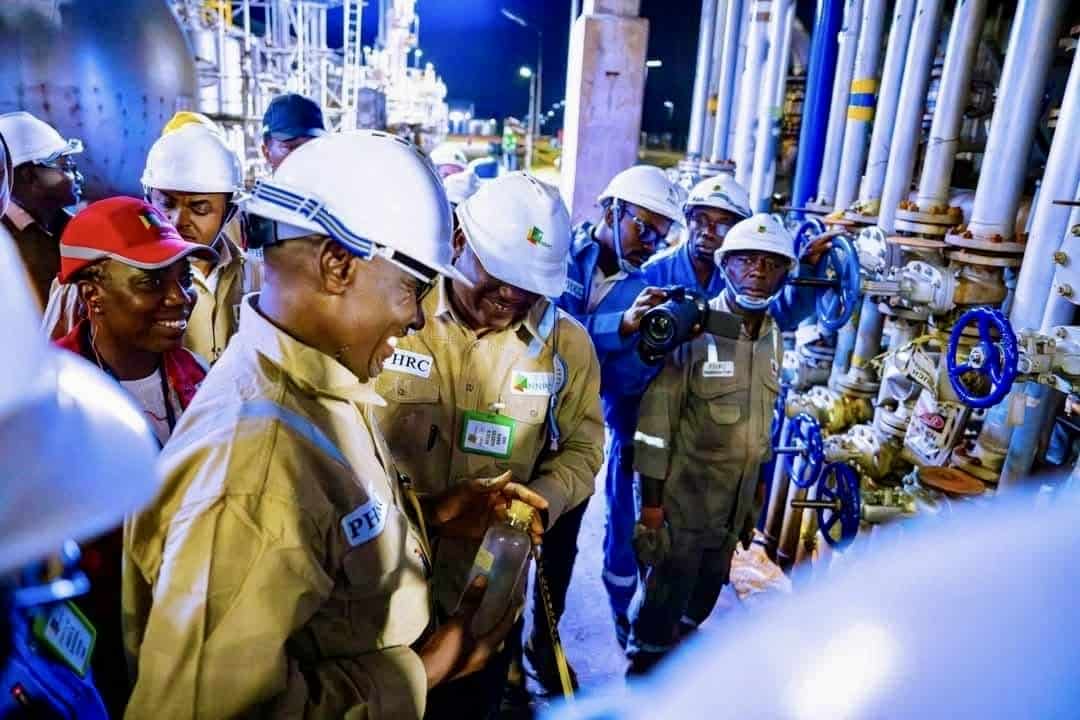
The Nigerian National Petroleum Company Limited (NNPCL) has once again found itself at the centre of controversy, as revelations emerge about its recent claims regarding the Port Harcourt Refinery’s operational status. The company’s announcement that it had begun trucking out Premium Motor Spirit (PMS), commonly known as petrol, from the refinery has been discredited by sources suggesting a deceptive scheme involving the use of cracked C5 petroleum resins blended with naphtha. This scandal raises questions about the integrity of NNPCL’s statements and the broader implications for Nigeria’s petroleum sector.
Unmasking the Refinery’s Real Output
NNPCL celebrated the resumption of activities at the Port Harcourt Refinery, with Group CEO Mele Kyari heralding it as a pivotal step towards energy independence. However, insiders have disclosed that the refinery’s 60,000 barrels-per-day (bpd) unit—originally commissioned in 1965—is incapable of producing PMS. This unit is designed to refine crude oil into diesel, leaving no capacity for the production of petrol as claimed by the company. The more modern 150,000 bpd unit, which could produce significant volumes of PMS, remains years away from functionality, with projections suggesting a 2026 completion
The Questionable Substitutes
According to whistleblowers within the refinery, the supposed PMS being transported is not a product of the facility but a blend of cracked C5 petroleum resins sourced from Indorama Petrochemical in Port Harcourt and naphtha. Cracked C5, a modified petroleum resin, is not a conventional component of PMS production but appears to have been repurposed to create a petrol-like mixture sold to consumers
This blending process, while financially expedient, raises concerns about the quality and safety of the fuel distributed under NNPCL’s watch. It also casts a shadow on the authenticity of the company’s claims, undermining public trust in an already beleaguered national oil corporation
Decades of Unrealised Promises
The Port Harcourt Refinery has been under rehabilitation since 2021, backed by a $1.5 billion renovation loan. Despite several projected completion dates, the facility has failed to meet its targets, leading to increasing skepticism. NNPCL initially promised the refinery would be operational by late 2023, but subsequent delays shifted the timeline to 2024. As of now, the plant’s partial operations appear to be a stopgap, with no clear roadmap for achieving its intended capacity
The repeated failures to deliver on these promises not only dent the reputation of NNPCL but also deepen Nigeria’s reliance on imported petroleum products. This dependency exacerbates the nation’s foreign exchange challenges, with billions spent annually on imports despite being Africa’s largest crude oil producer
Public Reaction and Economic Implications
The public outcry over these revelations reflects deep frustration with the government’s perceived inability to manage critical national assets effectively. Economic analysts have pointed to the delayed refinery operations as a major impediment to reducing fuel import bills and stabilising domestic supply. Calls for privatisation have grown louder, with experts arguing that private management might ensure greater efficiency and accountability
NNPCL’s current predicament highlights the urgent need for transparency in its operations and a comprehensive overhaul of its communication strategies. As stakeholders demand answers, the corporation must address these allegations and chart a credible course forward.
Cracks in the Foundation – NNPC’s Deceptive Practices and Structural Failures
A Deep Dive into NNPCL’s Misdirection
The ongoing revelations about the Port Harcourt Refinery underscore a systemic failure to deliver on promises of transparency and operational efficiency. At the core of the latest controversy is the deliberate misrepresentation of its fuel production capacity. By claiming to have begun trucking out PMS—a product that the refinery, in its current state, cannot produce—NNPCL has placed itself under intense public and expert scrutiny. The decision to blend cracked C5 petroleum resins with naphtha, as revealed by insiders, is seen by many as not just an operational compromise but an act of deceit designed to mask deeper inadequacies
Industry experts argue that such practices highlight the disconnect between NNPCL’s public relations efforts and the technical realities of its facilities. The reliance on alternative products like cracked C5, sourced from Indorama Petrochemicals, reflects the corporation’s struggle to meet domestic fuel demands through legitimate refining operations. It also raises significant safety and quality concerns, as these blended fuels may not meet the rigorous standards expected of refined PMS.
The Port Harcourt Refinery: A Symbol of Systemic Decay
The Port Harcourt Refinery has become a symbol of Nigeria’s broader petroleum sector challenges. Despite its storied history, the facility has consistently failed to deliver on its potential. Built in two phases—one in 1965 with a capacity of 60,000 barrels per day and another in 1989 with a 150,000 bpd capacity—it was once heralded as a cornerstone of Nigeria’s energy independence. Today, it stands as a stark reminder of mismanagement and inefficiency
The ongoing rehabilitation project, which began in 2021 with a $1.5 billion loan, was meant to restore the refinery to its full capacity. However, repeated delays have eroded public confidence. The older unit’s limited functionality and the prolonged downtime of the newer unit have forced the country to continue its dependence on imported petroleum products, exacerbating economic vulnerabilities
Economic Fallout: The Cost of Import Dependence
The consequences of the Port Harcourt Refinery’s dysfunction extend far beyond operational setbacks. Nigeria’s reliance on imported petroleum products costs the nation billions annually in foreign exchange—a staggering figure for a country struggling with currency instability. This reliance also leaves the domestic economy vulnerable to global market shocks, as demonstrated by recent fuel price hikes following international oil price fluctuations
Economists warn that unless Nigeria addresses its refining inefficiencies, these vulnerabilities will persist. The ongoing controversy surrounding the Port Harcourt Refinery’s output further complicates efforts to achieve energy security. With domestic fuel production still a distant reality, the nation faces a precarious balance of maintaining imports while grappling with fiscal deficits and inflation
Privatisation: A Path Forward?
Calls for the privatization of Nigeria’s refineries have gained traction in the wake of repeated failures by NNPCL to effectively manage these assets. Proponents argue that private sector involvement could bring much-needed expertise, efficiency, and accountability to the sector. However, privatization is not without its critics. Opponents point to the risk of job losses, reduced government control, and potential exploitation by private entities
Nevertheless, the current situation demands urgent action. The Port Harcourt Refinery’s rehabilitation delays and the deceptive practices surrounding its operations have underscored the need for a paradigm shift in Nigeria’s approach to energy management. For many stakeholders, privatization may offer the best hope of revitalizing the country’s refining capacity and ensuring a sustainable energy future
NNPCL’s Silence and the Need for Accountability
In light of these revelations, NNPCL’s silence has been deafening. The corporation has yet to provide a substantive response to the allegations of misrepresentation and operational inadequacy. This lack of accountability further erodes public trust and raises questions about the governance structures within NNPCL. Transparency advocates argue that without a thorough investigation and corrective measures, the corporation’s credibility will remain in tatters
Political Implications, Policy Failures, and the Global Spotlight
The Politics of Refinery Management
The unfolding controversy surrounding the Nigerian National Petroleum Company Limited (NNPCL) and the Port Harcourt Refinery has significant political undertones. Over the years, successive administrations have touted refinery rehabilitation as a cornerstone of their economic policies, promising to reduce fuel imports and bolster energy independence. These pledges have often formed the backbone of political campaigns, making the issue highly sensitive. However, the persistent inability to deliver on these promises exposes systemic governance failures
The recent revelations of blending cracked C5 resins with naphtha further fuel perceptions of a government disconnected from the realities of its citizens. As Nigerians grapple with skyrocketing fuel prices and inflation, such reports only deepen public disillusionment. Opposition parties and civil society groups have already seized on this scandal as evidence of the administration’s incompetence, using it to galvanise calls for more accountability in the petroleum sector
Policy Paralysis in the Energy Sector
The NNPCL debacle also underscores Nigeria’s broader policy paralysis in the energy sector. Despite being Africa’s largest crude oil producer, Nigeria continues to spend billions annually on fuel subsidies and imports. This paradox stems from decades of underinvestment in refinery infrastructure, mismanagement, and a failure to adapt to global energy trends
Efforts to reform the sector, such as the Petroleum Industry Act (PIA), have yet to yield tangible results. While the PIA was intended to attract investment and improve efficiency, its implementation has been hampered by bureaucratic inertia and conflicting interests. The Port Harcourt Refinery controversy illustrates the limitations of these reforms, particularly in addressing the deep-rooted inefficiencies within NNPCL
The International Dimension
The scandal has not only domestic but also international implications. Nigeria’s image as a reliable energy player has taken a hit, with global investors questioning the viability of its energy policies. The reliance on makeshift solutions, such as blending cracked C5 resins, suggests a lack of long-term planning and undermines confidence in the country’s ability to manage its natural resources effectively
Furthermore, Nigeria’s struggles with refinery management place it at odds with global energy trends. While other oil-producing nations are diversifying their economies and transitioning to cleaner energy sources, Nigeria remains mired in controversies over basic refining capacity. This lag in modernisation risks leaving the country behind in the global energy transition
The Path Forward: Reforms or Relapse?
For Nigeria to overcome these challenges, it must confront the structural deficiencies within NNPCL and the broader petroleum sector. Transparency must be prioritized, with independent audits of the Port Harcourt Refinery and other facilities to identify the root causes of inefficiency. Civil society groups and industry experts have called for greater stakeholder engagement in policy formulation, ensuring that decisions reflect the realities of the sector rather than political expediencies
Additionally, there is an urgent need to revisit the privatization debate. While privatization is not a panacea, it could introduce the accountability and expertise needed to revitalize Nigeria’s refineries. Lessons from other oil-producing nations suggest that strategic partnerships with private firms, coupled with robust regulatory oversight, can yield better outcomes than state-run operations
Public Sentiment and the Government’s Next Moves
The Nigerian public, weary of repeated promises and disappointments, is likely to demand immediate and tangible action. The government faces a critical test in how it handles this latest controversy. A failure to address the allegations could further erode trust and fuel unrest, particularly as Nigerians bear the brunt of economic hardships exacerbated by rising fuel prices
In the coming months, all eyes will be on NNPCL and the federal government to see whether they can restore credibility and chart a sustainable path for the petroleum sector. The stakes are high, not just for the current administration but for Nigeria’s long-term economic stability and global standing.