NDLEA cracks down on drug cartels, arresting a Lagos kingpin, Nollywood filmmaker, and others in a sweeping war on illicit trade. Will reform sustain this momentum?
Peter Jene
Atlantic Post Senior National Correspondent
Breaking the Silence: NDLEA’s Year-Opening Blitz Exposes Deep-Rooted Drug Syndicates


A Sensational Start to 2025
The National Drug Law Enforcement Agency (NDLEA) has commenced 2025 with a cascade of high-profile arrests and seizures that have unmasked the sinister depths of Nigeria’s drug underworld. From Lagos to Kwara, Rivers to Kano, and beyond, the agency executed sweeping raids that dismantled networks involving societal elites, ex-convicts, and students. This audacious move signals a renewed commitment to the War Against Drug Abuse (WADA) under the leadership of Brig. Gen. Mohamed Buba Marwa (Rtd).
The series of operations, detailed in a public statement by the NDLEA’s Director of Media and Advocacy, Femi Babafemi, highlights the persistent challenges facing Nigeria’s fight against illicit drugs. It also underscores the intricate nexus between crime, corruption, and societal decay.
The Fall of a ‘Drug Queenpin’ in Lagos
One of the most shocking revelations was the arrest of 61-year-old Alhaja Aishat Feyisara Ajoke Elediye, alias “Iya Ruka.” Operating under the guise of a successful fabric and shoe importer, Alhaja Ajoke led a sophisticated drug cartel based in Lagos’ Mushin area.
Her arrest followed the interception of a white Isuzu truck carrying an alarming 1,540 kilograms of cannabis concealed in jumbo sacks. The driver, Abideen Adio, was apprehended on the spot. Acting swiftly, NDLEA operatives stormed her mansion at 33 Adebayo Oyewole Street in Okota, Lagos, finally apprehending the elusive cartel leader.
The Double Life of Iya Ruka
To the public, Alhaja Ajoke was a socialite and the Iyalaje of Blessing Sisters, a powerful club of influential Lagos women. However, intelligence reports and undercover operations revealed her pivotal role in supplying illicit substances to various parts of Lagos and beyond. For years, her ability to evade justice had fed a myth of invincibility, which was shattered on New Year’s Day.
A Tale of Two Industries: Nollywood and Illicit Drugs
In an even more sensational twist, the NDLEA apprehended US-trained filmmaker and motivational speaker Emeka Emmanuel Mbadiwe. Known for his Hollywood and Nollywood connections, Mbadiwe’s arrest has sent shockwaves through Nigeria’s entertainment industry.
The Plot Unravels
On December 27, 2024, Mbadiwe’s partner, Uzoekwe Ugochukwu James, was caught at a warehouse in Ajao Estate, Ikeja, attempting to retrieve 33 parcels of Loud, a highly potent cannabis strain smuggled from the United States. Concealed in wooden boxes, the shipment had arrived via Delta Airlines at Murtala Muhammed International Airport (MMIA).
Further investigations led operatives to a Lekki hotel where Mbadiwe was staying. His arrest not only exposed his involvement in the drug trade but also raised questions about the complicity of prominent figures in fuelling Nigeria’s drug crisis.
The Shocking Reality of Drug-Laced Cakes
The NDLEA’s crackdown also revealed the disturbing trend of drug-laced edibles targeting students. In Kwara State, two young women—24-year-old graduate Khadijat Abdulraheem and 20-year-old University of Ilorin student Ayomide Morakinyo—were arrested for producing and selling drug-infused cupcakes.
A Growing Menace
The operation, carried out on December 29, 2024, exposed a distribution chain aimed at exploiting vulnerable youth. A search of their apartment yielded 42 drug-laden cakes, confirming intelligence reports about their activities.
This incident highlights the evolving strategies of drug dealers who now capitalize on innocuous-looking products to evade detection and infiltrate educational institutions.
Ex-Convicts and Passport Racketeering: A Double Threat
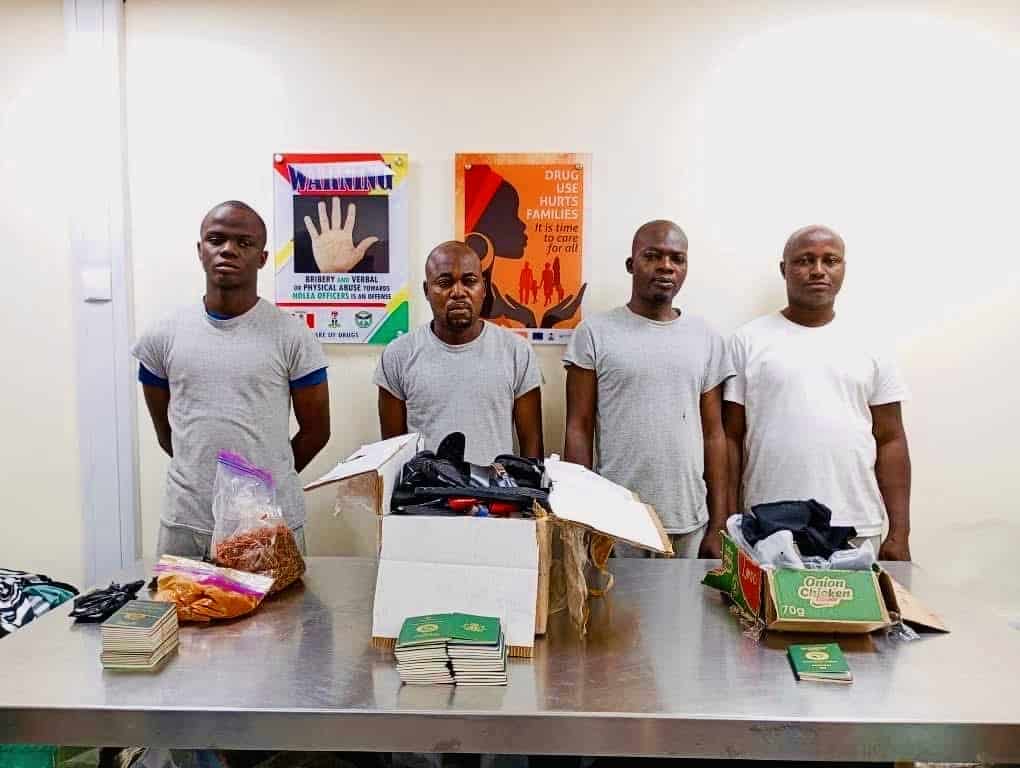
In a startling case of recidivism, ex-convict Sodade Sunday Eniola, previously jailed for drug trafficking, was arrested again for passport racketeering. Eniola had benefited from a lenient N750,000 fine imposed in June 2024, only to return to illicit activities.
NDLEA operatives uncovered 52 passports concealed in shoe soles and food items destined for Canada, Russia, and other countries. This operation, conducted at Lagos airport’s export shed, underscored the agency’s vigilance in combating sophisticated criminal syndicates.
Port Harcourt’s Codeine Crisis
Adding to the NDLEA’s string of successes was the seizure of 316,800 bottles of codeine-based syrup at the Port Harcourt Ports Complex. A joint operation involving customs officers and security agencies intercepted the illicit shipment concealed in containers.
Codeine abuse has long plagued Nigeria, with devastating consequences for public health. This significant haul represents a critical win in curbing the menace.
Kano’s Tramadol Trail
In Kano State, a raid on December 31, 2024, yielded 149,090 pills of tramadol and exol-5 from a local dealer. The suspect, Ismail Muhammad, had been operating in Dala Local Government Area, feeding an insatiable market for synthetic opioids.
The War Against Drug Abuse Continues
These arrests and seizures are a testament to NDLEA’s unwavering commitment to eradicating drug-related crimes. Yet, the underlying socio-economic factors driving the trade remain a pressing concern.
The NDLEA’s January operations are a wake-up call for Nigeria. The dismantling of high-profile drug syndicates signals progress but also reveals the entrenched networks fuelling the crisis. With prominent figures like Alhaja Ajoke and Mbadiwe in custody, the agency has struck a blow to the underworld.
Cracking Nigeria’s Drug Syndicate Code—Structural Loopholes and the NDLEA’s Uphill Battle
Unmasking the Underbelly of Nigeria’s Drug Trade
The NDLEA’s recent operations underscore the depth and complexity of Nigeria’s drug crisis. While the arrests of high-profile individuals like Alhaja Ajoke Elediye and Emeka Emmanuel Mbadiwe are significant victories, they reveal a much larger problem: a deeply entrenched system that enables and sustains the illicit drug trade.
From Lagos’ high-society circles to grassroots communities in Kwara and Kano, the drug trade has morphed into a multi-layered enterprise driven by corruption, economic inequality, and a failure of governance. This batch delves into the root causes and systemic enablers of Nigeria’s unrelenting drug crisis.
The Economic Drivers: Poverty and Unemployment as Catalysts
Nigeria’s economic challenges have created a fertile ground for the proliferation of drug syndicates. With an unemployment rate hovering around 33% and over 133 million Nigerians living in multidimensional poverty, desperation drives many into criminal enterprises.
A Case in Point
Alhaja Ajoke’s drug cartel, operating from Mushin, Lagos, is emblematic of how poverty-stricken areas become epicentres for illicit activities. For residents of Mushin, the lure of quick money often outweighs the risks. The cartel’s logistical network, from truck drivers like Abideen Adio to street-level peddlers, highlights the recruitment of vulnerable individuals who see no alternative paths to survival.
Similarly, the case of Khadijat Abdulraheem and Ayomide Morakinyo in Kwara reflects how young Nigerians, deprived of job opportunities, resort to innovative but illegal methods such as drug-laced cupcakes to make ends meet.
Corruption: The Cartels’ Secret Weapon
Corruption at various levels of governance and law enforcement remains one of the most significant challenges to Nigeria’s drug war. While the NDLEA’s recent successes are commendable, questions linger about the systemic rot that allows cartels to thrive.
Judicial Weaknesses and Leniency
The case of ex-convict Sodade Sunday Eniola is a glaring example. Despite being convicted of drug trafficking in June 2024, Eniola evaded a meaningful prison sentence by paying a paltry fine of ₦750,000. Within months, he was back at the airport, this time engaging in passport racketeering.
Such leniency not only emboldens criminals but also undermines the NDLEA’s efforts. How many other offenders have slipped through the cracks due to judicial compromises or poorly enforced penalties?
International Smuggling Networks: A Global Problem
The NDLEA’s interception of shipments from the United States, Canada, and Russia highlights the international dimension of Nigeria’s drug crisis. Cartels exploit Nigeria’s porous borders, weak customs oversight, and underfunded security agencies to establish smuggling routes.
The Mbadiwe Connection
The arrest of Nollywood filmmaker Emeka Mbadiwe reveals how influential figures exploit their global networks to facilitate drug trafficking. The shipment of Loud, a potent cannabis strain, concealed in wooden boxes and flown in from the U.S., speaks to the sophistication of these operations.
This case also raises questions about the complicity of international collaborators. How did such a shipment evade detection at its departure point in the U.S.? Could lax oversight in global supply chains be aiding Nigerian cartels?
The Role of Technology in the Drug Trade
Modern drug syndicates are increasingly leveraging technology to evade detection and expand their operations. From encrypted communication channels to digital payment systems, the illicit trade has gone high-tech.
Emerging Trends
The production and sale of drug-laced edibles, as seen in the Kwara operation, demonstrate how cartels are innovating to reach younger demographics. Social media platforms and messaging apps are often used to market these products, making detection even more challenging.
NDLEA’s Digital Response
To counter these trends, the NDLEA must invest in advanced surveillance technologies and cybercrime units. While its recent successes are laudable, a robust digital strategy is crucial for long-term victories against tech-savvy cartels.
Societal Normalisation of Drug Use
Another critical enabler of Nigeria’s drug crisis is the gradual normalisation of drug abuse, particularly among young people. Tramadol, codeine, and cannabis have become alarmingly accessible, with many users viewing them as recreational or stress-relief substances rather than harmful drugs.
The Kano and Port Harcourt Cases
The Kano raid, which recovered over 149,090 pills of tramadol and exol-5, and the Port Harcourt seizure of 316,800 bottles of codeine-based syrup are stark reminders of the scale of the problem. These substances, often sold cheaply, are readily available in markets and even pharmacies despite strict regulations.
Cultural Shifts
The NDLEA’s War Against Drug Abuse (WADA) campaigns aim to change societal attitudes, but their impact remains limited without broader cultural and policy shifts. How can a society combat drug abuse when influential figures like Mbadiwe and Alhaja Ajoke normalise such activities through their high-profile lifestyles?
The NDLEA’s Operational Challenges
While the NDLEA’s recent operations are a testament to its resilience, they also expose the agency’s limitations.
Funding and Resources
The agency operates on a constrained budget, limiting its capacity to execute more extensive and sustained operations. Advanced equipment, training programs, and personnel expansion are urgently needed to combat the ever-evolving drug trade.
Inter-agency Collaboration
The Port Harcourt codeine seizure exemplifies the benefits of joint operations with customs and other security agencies. However, such collaborations are not the norm. Fragmented efforts and bureaucratic bottlenecks often hinder the NDLEA’s efficiency.
A System in Need of Overhaul
The NDLEA’s recent successes highlight its potential but also reveal the systemic weaknesses that perpetuate Nigeria’s drug crisis. Economic disparities, corruption, international smuggling networks, and societal normalisation of drug use all contribute to a deeply entrenched problem.
Breaking the Cycle: Long-Term Solutions for Nigeria’s Drug Epidemic
Despite commendable victories, the NDLEA’s war on drugs is far from over. For sustainable success, a multi-pronged strategy targeting policy reforms, systemic accountability, and grassroots engagement is essential.
Policy Reforms: The Need for Stringent Laws and Better Enforcement
Nigeria’s legal framework for combating drug crimes needs urgent revamping. Current penalties, as demonstrated in cases like Sodade Sunday Eniola’s, are insufficient deterrents.
Recommendations
- Mandatory Sentencing for Drug Offenders: Introduce stricter, non-negotiable prison terms for drug trafficking and related crimes.
- Asset Seizure Laws: Empower the NDLEA to confiscate assets linked to drug syndicates, depriving them of their financial lifelines.
- Judicial Oversight Mechanisms: Establish independent panels to oversee judicial processes in drug cases, ensuring transparency and accountability.
Global Benchmarks
Countries like Singapore and the UAE, known for their zero-tolerance drug policies, can serve as models. Their combination of strict laws and effective enforcement has significantly reduced drug-related crimes.
Strengthening the NDLEA: A Call for Institutional Support
To remain effective, the NDLEA must evolve into a technologically advanced, well-funded, and autonomous agency.
1. Increased Budgetary Allocations
The current funding levels do not match the scale of the drug crisis. A larger budget would enable:
- Acquisition of state-of-the-art surveillance and detection equipment.
- Recruitment and training of more operatives.
- Expansion of operations to rural and border areas.
2. Inter-agency Collaboration
Joint efforts with customs, immigration, and international agencies must become the standard. The recent Port Harcourt seizures and passport racketeering busts demonstrate the potential of such partnerships.
3. Digital Intelligence Units
The NDLEA must establish specialised units to monitor dark web transactions, encrypted communications, and online marketplaces where drugs and counterfeit documents are traded.
Community Engagement: Winning the War from Within
The NDLEA’s War Against Drug Abuse (WADA) program has laid a foundation for grassroots engagement, but more needs to be done to tackle the cultural normalisation of drug use.
1. Educational Campaigns
- Curriculum Integration: Introduce mandatory drug education programs in schools.
- Parent-Teacher Workshops: Equip families with the knowledge to identify and combat drug use among teenagers.
2. Youth Empowerment Programmes
- Create job training and entrepreneurship opportunities targeting vulnerable populations in drug-prone areas.
- Partner with NGOs to provide rehabilitation and reintegration services for former drug users.
3. Public Awareness Drives
- Leverage Nollywood and other creative industries to produce anti-drug films and campaigns.
- Mobilize religious and community leaders to champion drug-free lifestyles.
Systemic Accountability: Tackling Corruption and Inefficiency
Corruption within law enforcement and judicial systems is a major obstacle in the fight against drug cartels.
Suggested Reforms
- Whistleblower Protection: Encourage insiders to expose corrupt practices without fear of retaliation.
- Digital Tracking Systems: Implement blockchain-based systems to track case files, ensuring that cases are not tampered with or delayed.
- Periodic Audits: Conduct regular audits of NDLEA operations and judicial proceedings to identify and address lapses.
NDLEA’s Strategic Vision for a Drug-Free Nigeria
Under the leadership of Brig. Gen. Buba Marwa, the NDLEA has demonstrated a balanced approach to supply and demand reduction. Moving forward, the agency must:
- Strengthen international partnerships to disrupt global smuggling networks.
- Invest in research to understand emerging drug trends and develop effective countermeasures.
- Enhance data-driven operations, utilising analytics to predict and prevent drug activities.
Final Thoughts: Sustaining the Momentum
The NDLEA’s recent operations have set a new benchmark for drug enforcement in Nigeria. However, the road ahead remains fraught with challenges. Only through comprehensive reforms, sustained community engagement, and unwavering political will can Nigeria hope to dismantle its drug cartels and reclaim its future.
The arrests of Alhaja Ajoke Elediye, Emeka Mbadiwe, and others are victories worth celebrating, but they are merely the beginning of a larger war. The question remains: will the NDLEA’s efforts be met with the systemic support needed to effect lasting change?