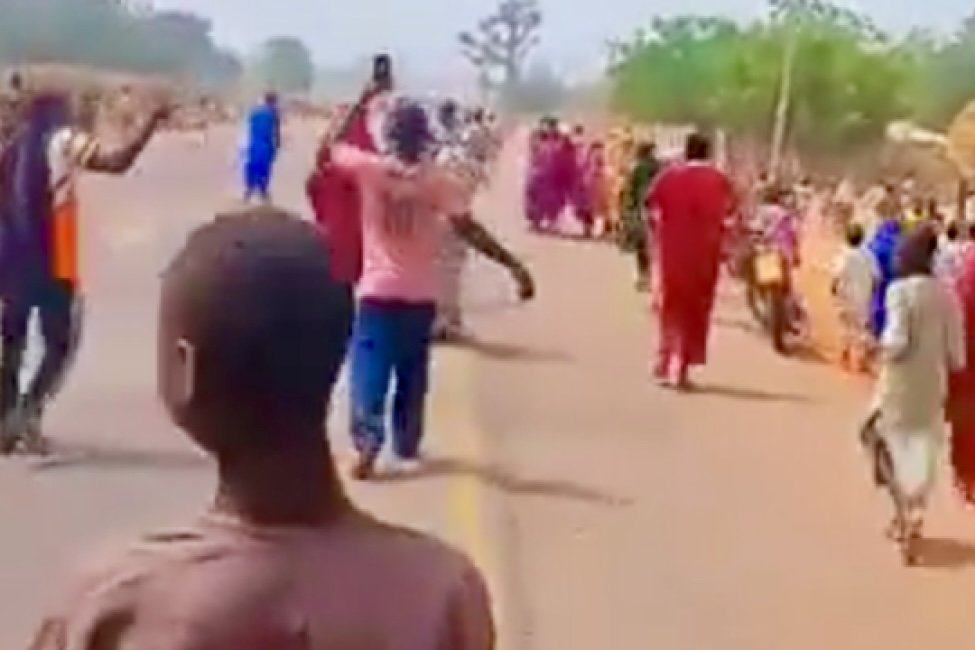
ABUJA, Nigeria — Tension escalated at Nigeria’s Federal Ministry of Finance on Monday as hundreds of indigenous contractors barricaded the ministry’s entrance, preventing Minister of State Doris Uzoka-Anite from accessing the complex.
The protesters operated under the All Indigenous Contractors Association of Nigeria (AICAN). They blocked the main gate with vehicles and placards. This was a demonstration over long-unpaid project fees.
Security operatives attempted to clear a path for the minister’s convoy, but a confrontation ensued during which a gunshot was fired into the air to disperse the crowd.
The contractors stood their ground, chanting “How many people government go kill?” – a defiant refrain in pidgin English questioning how many citizens the government would kill rather than pay its debts .
Despite the gunfire warning, the demonstrators insisted their protest was peaceful and solely aimed at obtaining long-overdue payment. AICAN’s Vice President, Fredrick Agada, decried the use of force, accusing authorities of intimidation instead of addressing the contractors’ grievances.
“This is a peaceful protest. We are harmless. We are just sitting down peacefully. We are demanding our money, our payment,” Agada said. He reaffirmed that the group remained non-violent even as frustration with official inaction boiled over.
Mounting Debts and Contractors’ Distress
The indigenous contractors claim the federal government has not paid them for many completed infrastructure projects. This is despite funds being appropriated for those payments in the 2024 and 2025 budgets.
They allege that monies earmarked for contractors in those budgets were never released, leaving many firms stuck in limbo.
After months – in some cases years – of waiting for payment, contractors say they have slid into severe financial distress. Some are unable to service the bank loans they took to execute the projects.
Mounting unpaid obligations have affected members who borrowed to finance government contracts. Tightening cashflow conditions and rising loan defaults have also impacted them. The seizure of assets has further complicated the situation, AICAN President Jackson Nwosu said.
The prolonged delays have pushed several local contracting firms to the brink of bankruptcy. The association has linked several contractor suicides to the intense financial strain of running projects without reimbursement.
AICAN’s leadership also disputes official assertions that most outstanding bills have been settled. Some government officials reportedly claimed that about 80% of overdue contractor invoices were paid. However, Nwosu insists the true figure is no more than 30–40% of verified claims.
He noted that the government stopped issuing payment warrants in May 2025. Contractors kept working without compensation. This caused unpaid liabilities to balloon beyond ₦4 trillion (N4tn).
According to Nwosu, even payments that were “finalised” before the Treasury’s payment portal was shut at the end of December 2025 never actually reflected in contractors’ accounts. This highlights a gap between government pronouncements and the reality on the ground.
For 2024 projects alone, AICAN’s records show roughly ₦760 billion worth of completed works awaiting payment. This is out of over ₦2 trillion in projects executed that year.
Even after the National Assembly intervened last year, the government was authorised to borrow more than ₦1 trillion. This money was intended to finance the outstanding liabilities. However, contractors say hardly any of those funds have reached them.
This disconnect between budgetary promises and actual cash releases has eroded contractors’ trust and exacerbated their cash crunch. Many report being incapable of paying staff or suppliers, setting off a chain reaction of economic pain.
Government Response and Budget Measures
Finance ministry officials have been under increasing pressure to resolve the debt impasse. In December 2025, President Bola Tinubu set up a multi-ministerial committee. The committee’s task was to verify and clear the outstanding contractor debts, which were officially estimated at about ₦1.5 trillion at the time.
The committee comprises several key figures. These include the Ministers of Finance (Wale Edun), Budget & Economic Planning (Atiku Bagudu), Works (Dave Umahi), and Housing (Ahmed Dangiwa). It also includes the Budget Office Director-General (Tanimu Yakubu) and the Federal Inland Revenue Service Chairman (Zacch Adedeji). Their task was to find a path to settle the obligations.
Meanwhile, the Senate has summoned Finance Minister Wale Edun. They want him to explain the prolonged delay in payments. This summons reflects lawmakers’ concern that the executive’s inaction is harming credibility. It also affects economic activity.
Facing public outcry and protests, the federal government has now explicitly acknowledged the debts in its fiscal planning. The proposed 2026 national budget includes dedicated provisions to finally pay off the arrears owed to contractors. Notably, the budget earmarks:
₦1.7 trillion is listed under a line item for “2024 Outstanding Contractor’s Liabilities.” It is allocated to settle unpaid bills for projects completed in 2024. ₦100 billion is designated under “Payment of Local Contractors’ Debts/Other Liabilities.” This amount is intended for legacy obligations from previous years. It also covers smaller contract claims or other verified unpaid commitments.
These allocations total ₦1.8 trillion, forming part of a broader ₦23.2 trillion capital expenditure plan in 2026 that aims to spur infrastructure development while cleaning up past obligations .
These budgetary measures show official recognition of the problem. However, they effectively push the bulk of payments into the new fiscal year. This validates contractors’ fears of further delay.
AICAN leaders have warned that this approach simply shifts their dues into another cycle after they’ve already waited so long. In December, during an earlier protest, they accused officials of trying to defer payments to 2026. This would worsen contractors’ financial woes.
“They want to push us into a backlog… to 2026. They will turn us into debt, and we don’t want that. We won’t leave here until we are paid.” AICAN Secretary-General Babatunde Oyeniyi declared at the December demonstration. He vowed not to accept being rolled over into yet another year’s budget.
Recurring Protests and Economic Fallout
This week’s blockade is only the latest escalation in a series of protests by unpaid contractors. In November 2025, AICAN members besieged the National Assembly for two consecutive days. This action forced the House of Representatives to suspend plenary sessions for a week.
The lawmakers intervened by summoning senior finance officials. They issued a seven-day ultimatum to the Finance Minister and others, including Budget Minister Atiku Bagudu and the Accountant-General. The ultimatum required them to pay all outstanding debts. It also demanded the implementation of the 2025 budget provisions for contractors.
The contractors agreed to call off that protest after receiving assurances of swift action. Yet those promises never materialised into actual payments. According to AICAN, after the National Assembly’s mediation, the Finance Ministry went largely silent on the issue. This prompted the contractors to resume demonstrations just weeks later when no money came through.

In early December 2025, hundreds of contractors gathered at the Finance Ministry again. In one instance, they dramatically brought a mock coffin to the ministry gates. This act was a morbid symbol of how their enterprises were “dying” under the weight of unpaid bills.
The protesters accused the ministry of repeatedly shifting its position and making unfulfilled promises despite multiple meetings. AICAN leaders revealed that the Finance Ministry had signed an agreement to pay about ₦760 billion. The amount had been verified for disbursement, yet no funds were released.
They noted that some payment warrants were issued on paper. However, those authorisations had no cash backing. The money simply didn’t follow. In one meeting, officials claimed around ₦150 billion was ready to be paid out to indigenous contractors. The association says none of its members ever received such funds.
Each time a deadline or pledge was missed, the contractors’ frustration grew. This led them to escalate their protests. They wanted to force accountability.
Local contractors say their despair is compounded by a sense of double standards. They claim that foreign construction firms – especially those connected to powerful figures – often get paid promptly. In contrast, indigenous Nigerian contractors face endless delays.
AICAN has stressed that domestic contractors should not be treated differently from foreign companies. It insists they deserve the same timely payments for work done.
The prolonged non-payment is not only a private business problem; contractors warn it is wreaking wider economic damage. Many Nigerian banks now hesitate to finance government-awarded projects. The high risk of non-payment causes this hesitation. As a result, credit for the infrastructure sector is drying up.
“Banks no longer have confidence in sponsoring government projects. The reason is that contractors are not being paid,” one protester lamented. He noted that this credit freeze stalls new projects. It can also drive up costs.
The continued neglect of indigenous contractors is “hurting the domestic economy.” It is also worsening financial distress in the industry, Oyeniyi of AICAN observed.
Billions of naira are locked up in unpaid contracts. Projects have been left in limbo. Workers have been laid off, and suppliers remain unpaid. This situation creates a ripple effect that undercuts the government’s own development agenda.
Some contractors bluntly described the situation as “killing small businesses.” They said delaying payments for nearly a year amounts to “fraud, not just injustice” by the state.
Outlook: The indigenous contractors have vowed to continue their demonstrations. They will do so until all verified payments are fully settled. They refuse to accept partial measures or further delays.
Each day the standoff continues, pressure mounts on the government to disburse the funds. The government must also restore confidence in its handling of public contracts.
A Senate committee’s inquiry with Minister Wale Edun will happen in the coming days. It will seek answers for the delay. President Tinubu’s debt-clearing committee is expected to propose a concrete payment plan.
Observers note that this crisis highlights deeper structural weaknesses in Nigeria’s public finance management.
The contractor debt backlog has become a recurring fiscal issue. It is made worse by delayed capital budget releases. Only partial cash-backing of allocated funds adds to the problem. Revenue shortfalls also hinder the government’s ability to pay its bills.
Addressing the immediate arrears in the 2026 budget may bring temporary relief. But, without reforms to guarantee timely payments, such crises could repeat. Efficient budget execution is also necessary to prevent these issues. Otherwise, they will continue to undermine local businesses.
For now, the message from Nigeria’s indigenous contractors is loud and clear. They will not back down in their quest for financial justice. They have already borne the brunt of unpaid labour and broken promises.
Follow us on our broadcast channels today!
- WhatsApp: https://whatsapp.com/channel/0029VawZ8TbDDmFT1a1Syg46
- Telegram: https://t.me/atlanticpostchannel
- Facebook: https://www.messenger.com/channel/atlanticpostng