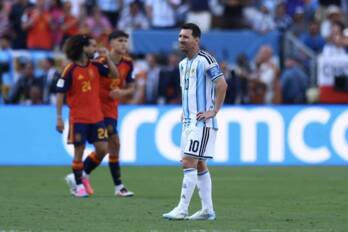
Lionel Messi’s first public reaction to Argentina’s defeat by Spain in the 2026 FIFA World Cup final was raw, reflective and unmistakably emotional. Hours after the Albiceleste lost 1-0 in extra time in New York/New Jersey on Sunday, the Argentina captain posted on Instagram that the pain was “immense” and that the wound would be difficult to close.
FIFA’s official match record confirms that Spain won the final 1-0 after extra time on 19 July 2026, securing their second men’s World Cup title.
Messi did not address reporters immediately after the final, but his online statement gave a clear sense of the emotional toll. Among the most striking lines from his post were:
“The pain is so great,” “Today it’s hard to evaluate what we did,” and “I also want to congratulate Spain.”
He also thanked supporters across Argentina for the countrywide unity the run had inspired. Reuters reported that the message followed a final in which Messi’s Argentina were beaten by Ferran Torres’ extra-time winner.
What makes Messi’s response more significant is not just the defeat itself, but the scale of the journey Argentina completed before falling at the last hurdle.
Reuters noted that Messi became only the second male player, after Brazil legend Cafu, to appear in three World Cup finals, while Argentina reached consecutive finals for the first time since the modern era of the competition.
That alone underlines how far Lionel Scaloni’s side had travelled, even if the final scoreline denied them a successful title defence.
There was also a tactical sting in the defeat. Reuters reported that Argentina failed to produce a shot during regular time in a World Cup final for the first time ever, reflecting a game plan that leaned heavily on disruption, restraint and survival rather than sustained attacking risk.
Spain dominated possession and eventually found the breakthrough in extra time through Torres. In a match billed as a heavyweight showdown between two football giants, the football itself was often tight, cautious and, for long stretches, flat.
For Spain, the final confirmed a return to the summit of world football. FIFA’s official match page and Reuters’ reporting show that the victory gave Spain their second World Cup crown, the first since 2010, and ended Argentina’s attempt to retain the trophy they won in Qatar in 2022.
The result also intensified the long-running debate over how Messi’s international legacy should be judged: not by one defeat, but by the extraordinary fact that he has remained central to elite tournament football across three finals and two generations of teammates.
The fallout has not been limited to Messi’s personal disappointment. Reuters also reported that FIFA has opened an investigation into a post-match brawl that flared after the final whistle, with Argentine midfielder Leandro Paredes among those involved as tempers spilled over.
That detail is important because it shows how thin the line can be between sporting heartbreak and disciplinary trouble when the pressure of a World Cup final boils over.
From a broader sporting perspective, Messi’s post was exactly what many expected from a captain who has long spoken with his feet rather than his ego. It was not a defensive statement, nor a bitter one. It was a leader’s admission that the defeat hurt, combined with a deliberate effort to preserve the value of the campaign itself.
Argentina did not retain the trophy, but they reached the final again, carried the expectations of a nation, and left the tournament with their standing as a football power intact.
Follow us on our broadcast channels today!
- WhatsApp: https://whatsapp.com/channel/0029VawZ8TbDDmFT1a1Syg46
- Telegram: https://t.me/atlanticpostchannel
- Facebook: https://www.messenger.com/channel/atlanticpostng