Discover the dramatic protests led by MOSOP in Ogoniland, as local groups demand justice for Ken Saro-Wiwa and an inclusive, transparent process in oil resumption, challenging decades of marginalisation.
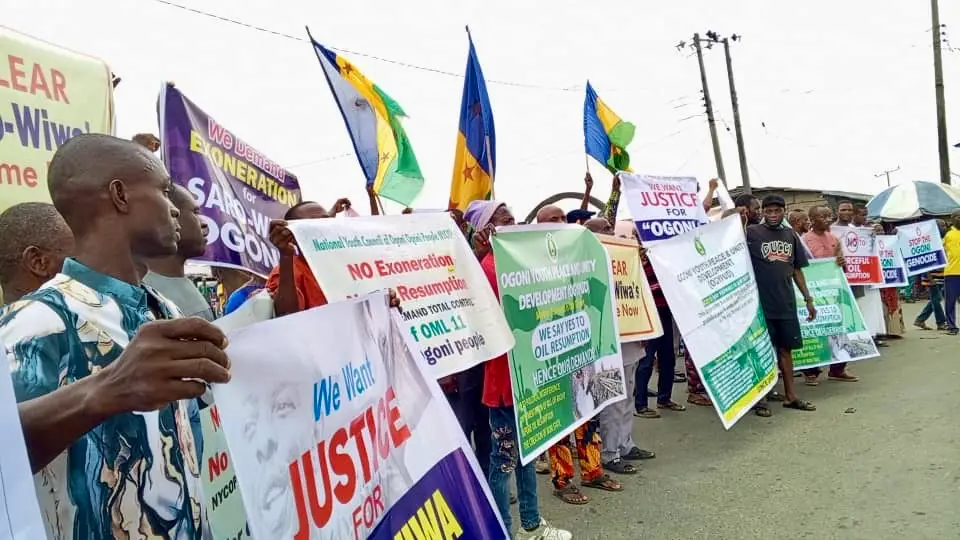
BORI, Nigeria — In a fervent display of resistance and determination, the Movement for the Survival of the Ogoni People (MOSOP) – alongside thirty influential groups – has staged a powerful protest in Bori, Ogoniland.
The demonstrators, united under the banner of justice and environmental stewardship, have issued an unequivocal threat to disrupt the planned oil resumption process, a move they claim would bypass the rights and voices of the Ogoni people.
For decades, the Ogoni struggle has symbolised the fight against environmental degradation and systemic injustice.
The protest in Bori, which saw thousands marching with placards demanding “No exoneration, no oil resumption in Ogoniland” and “Clear Ken Saro-Wiwa Name now”, underscores a deep-seated refusal to accept decisions imposed without local consensus.
The placards, inscribed with potent slogans such as “Stop the Ogoni genocide” and “We want justice for Ogoni 9”, reflect not only the historical grievances of the community but also a demand for accountability in how Nigeria’s vast oil resources are managed.
At the heart of the protest is the legacy of Ken Saro-Wiwa, the renowned environmental activist and writer whose execution in 1995 – alongside the Ogoni Eight – has long been a rallying cry for environmental justice and human rights.
His sacrifice remains a symbol of the Ogoni people’s enduring resilience. MOSOP President Mr Fegalo Nsuke, addressing the gathering at Peace Park in Bori, stressed that the future of oil exploration in Ogoniland must be driven by the MOSOP Development Programme.
“We will not accept any decision that is imposed on us without our input,” he declared, emphasising the organisation’s pioneering role in both the struggle against corporate exploitation and the fight for local empowerment.
Nsuke’s address is particularly poignant against the backdrop of an oil industry still scarred by the shadow of Shell’s departure from Ogoni lands in 1993.
The protesters have voiced a series of uncompromising demands – from the exoneration of Ken Saro-Wiwa to the granting of operational licences to indigenous Ogoni companies, as well as the unbundling of Oil Mining Licence 11 (OML11) and the provision of adequate compensation to affected communities.
Such demands are not merely symbolic; they represent a call for a reformed approach to oil exploration that places the rights and welfare of the people above corporate interests.
Adding further momentum to the protest, Barinuazor Emmanuel, President of the National Youth Council of Ogoni People (NYCOP), reiterated the collective call for transparency.
He urged the federal government, and specifically President Tinubu, to reconsider the current process orchestrated by the Office of the National Security Adviser (ONSA).
“We want the federal government to recognise our rights as Ogoni people and to involve us in the decision-making process regarding oil exploration in our land,” Emmanuel asserted.
As the protest rages on, the clash between the government’s strategic ambitions and the resolute demands of the Ogoni people has ignited a national debate.
With the fate of oil resumption hanging in the balance, the coming days are set to reveal whether the federal government will heed the passionate calls for justice and local empowerment.
- Additional report by Omonigho Macaulay, Atlantic Post National Correspondent