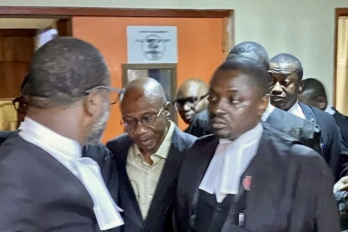
The corruption trial of former Central Bank of Nigeria governor, Godwin Emefiele, took another damaging turn on Tuesday when the Federal Capital Territory High Court in Abuja heard that some suspects allegedly confessed to the fraudulent withdrawal of $6.23 million from the apex bank.
The Economic and Financial Crimes Commission says the cash was removed under the guise of funding foreign election observers for the 2023 general election, while Emefiele continues to deny the amended 20-count charge against him before Justice Hamza Muazu.
The witness at the centre of the latest hearing, Eloho Edwin Okpoziakpo, a Commissioner of Police attached to the Special Fraud Unit in Lagos, told the court that he and three other officers were drafted in to assist Jim Obazee, the special investigator appointed by President Bola Tinubu to probe the CBN and other government business entities.
His team, he said, took statements, interrogated suspects and provided intelligence support as investigators attempted to trace how the money left the CBN’s Abuja branch.
According to Okpoziakpo, intelligence received during the probe showed that the $6.23 million was fraudulently withdrawn with approval allegedly linked to Emefiele.
He told the court that the investigation produced confessional accounts from some suspects, including one identified as Maishanu, and that the Office of the Secretary to the Government of the Federation denied ever requesting funds for election observers.
In his words, the matter was processed and “the money was paid”, a phrase that captures the central prosecution theory that the transaction moved through official-looking paperwork but was allegedly not what it purported to be.
The evidence also pointed to a paper trail that prosecutors say was used to legitimise the release. Okpoziakpo identified a request for the funds addressed to Emefiele and a purported presidential approval dated 24 January 2023 as part of the exhibits already admitted by the court.
He further said he personally recovered exhibits from the CBN Abuja branch, where the cash was reportedly disbursed in $100 bundles on 8 February 2023.
Those details matter because they push the case beyond a broad allegation of abuse of office and into the territory of document handling, internal approvals and the identity of the officials who moved the cash.
Tuesday’s testimony did not emerge in isolation. On 27 April, another prosecution witness, Chinedu Eneanya, told the court that the EFCC’s investigation found the $6.23 million had been removed from CBN coffers for a supposed foreign election-monitoring exercise, and that documents authenticating the release had been recovered from the bank. The investigation pointed to forged signatures of former President Muhammadu Buhari and former Secretary to the Government of the Federation Boss Mustapha, allegedly used to obtain the cash.
If sustained, that allegation strikes at the core of the prosecution’s case, because it suggests that the release was not merely irregular but was anchored on fabricated authority.
The wider trial has already shown signs of strain. In March, Justice Muazu fined the EFCC N500,000 after the commission failed to produce its next witness and stalled proceedings.
That same court has now pushed harder on witness attendance, having subpoenaed both Okpoziakpo and Jim Obazee to appear and continue testifying from day to day.
The sequence suggests a trial that is not only about the merits of the allegations, but also about the pace, discipline and preparedness of the prosecution team.
Emefiele’s position remains unchanged. He has pleaded not guilty to the amended charges, which include criminal breach of trust, forgery, abuse of office, conspiracy to obtain by false pretence and unlawful receipt of funds.
The EFCC also says the case involves corrupt advantages allegedly conferred on two companies, April 1616 Nigeria Ltd and Architekon Nigeria Ltd.
Those strands make the file one of the most watched financial crime trials connected to Nigeria’s public institutions in recent years, with the CBN’s internal processes, presidential approvals and election-related spending all under scrutiny.
The defence, however, is likely to keep pressing on proof. A witness can describe what investigators say suspects admitted, but the prosecution still has to convince the court that the approvals were fake, the cash movement was unlawful, and Emefiele personally authorised a scheme rather than a disputed administrative transaction.
The next hearing, now fixed for 2 July 2026, will be closely watched for whether the state can turn the current wave of testimony into a coherent and legally durable case.
Follow us on our broadcast channels today!
- WhatsApp: https://whatsapp.com/channel/0029VawZ8TbDDmFT1a1Syg46
- Telegram: https://t.me/atlanticpostchannel
- Facebook: https://www.messenger.com/channel/atlanticpostng