By Editor
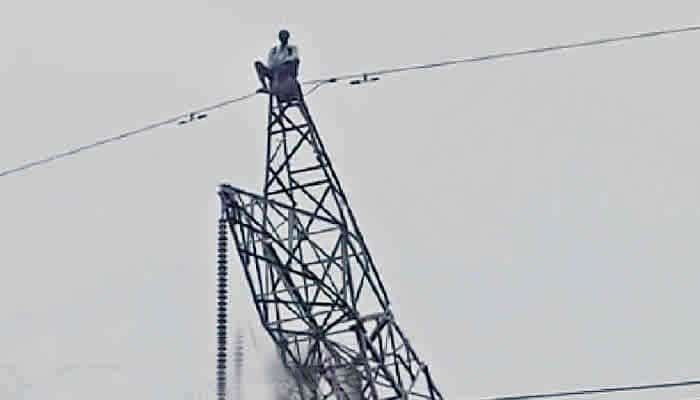
In an unprecedented twist of events, the Adamawa State Police Command has admitted 30-year-old Abdullahi Mohammed to the Yola Psychiatric Hospital following his bizarre protest in Mayo-Belwa. Mohammed had climbed a dangerous 33kv high-tension electricity pole, claiming that he would not descend until President Bola Tinubu vacated the presidential villa. The dramatic scene that unfolded left many Nigerians stunned and sparked widespread debate about whether this incident was a form of political expression or the result of mental instability exacerbated by drug use.

The Adamawa Police Public Relations Officer, SP Suleiman Nguroje, in an exclusive interview with Arewa PUNCH, confirmed that Mohammed is currently undergoing psychiatric evaluation at a facility inside Yola Specialist Hospital. According to Nguroje, when the police rescued Mohammed, they found him in possession of hard drugs, including substances he identified as Indian hemp. This raised immediate suspicions of drug-induced psychosis, and a comprehensive medical examination was deemed necessary before the authorities could proceed with formal charges.
But is this a straightforward case of mental health and drug abuse? Or is there a deeper, more complex layer to Mohammed’s actions? Could it be that this seemingly suicidal gesture was a desperate political statement by a disenfranchised citizen, calling into question the legitimacy of Bola Tinubu’s presidency? In a country where political discontent is rife, many are inclined to view Mohammed’s protest as an extreme, albeit misguided, act of civil disobedience. In this in-depth report, we delve deep into the psychological, political, and legal implications of this shocking incident.
A Suicidal Protest or Political Despair?
Nigeria has a long and tumultuous history of political protests, with citizens frequently taking to the streets to voice their dissatisfaction with government policies, election outcomes, or the behaviour of public officials. However, Abdullahi Mohammed’s method of protest is unusual, to say the least. His decision to climb a high-tension electricity pole on a busy market day in Mayo-Belwa is not only dangerous but also eerily symbolic. Electricity poles are a lifeline for Nigeria’s power grid, but they also represent the country’s frequent and devastating power failures—an issue that has plagued successive governments, including the current administration led by Bola Tinubu.
Could it be that Mohammed’s climb is a metaphor for the state of the nation? Is Nigeria, like the man on the pole, teetering on the edge of self-destruction, with its leaders unable to keep it grounded? Or was his action simply the result of an unbalanced mind under the influence of drugs, as the police would have us believe?
Nguroje’s statements to the press seem to support the latter view. According to the police spokesman, Mohammed was found with hard drugs, including Indian hemp, which he admitted to consuming regularly. The connection between substance abuse and mental illness is well-documented, and it is possible that Mohammed’s drug use triggered a psychotic episode, leading him to engage in such dangerous behaviour.
However, it would be simplistic to dismiss Mohammed’s actions as merely the result of drug-induced madness. His demand for President Bola Tinubu to resign suggests that his protest, however irrational it may seem, was rooted in political frustration. After all, Nigeria has witnessed several controversial elections, and Tinubu’s rise to power has not been without its fair share of challenges and allegations of irregularities.
The Tinubu Presidency: A Nation Divided
Since taking office, Bola Tinubu has faced growing discontent from various sectors of Nigerian society. His administration’s economic policies, especially the removal of fuel subsidies and the devaluation of the naira, have led to a sharp increase in the cost of living, making life increasingly difficult for ordinary Nigerians. Furthermore, allegations of electoral fraud continue to taint his presidency, with some critics accusing him of manipulating the electoral process to secure his victory.
Could Mohammed’s protest be a reflection of this discontent? While his method may have been extreme, the sentiment behind his actions is not unique. Across Nigeria, many citizens feel disenfranchised, believing that the government does not represent their interests. In this context, Mohammed’s climb could be interpreted as a desperate attempt to draw attention to the plight of ordinary Nigerians who feel that their voices are not being heard.
In fact, his demand for Tinubu to resign aligns with the calls of opposition parties and civil society groups who have questioned the legitimacy of the 2023 election results. While most Nigerians would never go to the lengths Mohammed did, his protest serves as a stark reminder of the deep political divisions in the country. It also highlights the lengths to which some individuals are willing to go to make their voices heard in a political landscape that often seems indifferent to the concerns of the populace.
Mental Health and the Nigerian Justice System
The legal implications of Mohammed’s actions are another aspect of this story that cannot be ignored. Under Nigerian law, attempting suicide is a criminal offences, and Nguroje confirmed that Mohammed could face charges if the psychiatric evaluation deems him mentally competent. The spokesman emphasised that it is the constitutional duty of the police to protect lives and property, and that includes preventing individuals from taking their own lives.
But this raises a critical question: should a person who is potentially suffering from mental illness be prosecuted for actions that may be the result of their condition? In many parts of the world, there is a growing recognition that individuals who attempt suicide are in need of medical and psychological support, not punishment. However, Nigeria’s criminal code still treats suicide attempts as a criminal act, and the legal system often fails to adequately address the underlying mental health issues that lead individuals to such extreme measures.
Mohammed’s case has brought this issue to the forefront, sparking debate about the need for legal reforms that would decriminalise suicide attempts and provide greater support for mental health services. The fact that the police are waiting for the results of Mohammed’s psychiatric evaluation before deciding on the next course of action is, in itself, a positive development. It suggests that the authorities are at least considering the possibility that Mohammed’s actions were not entirely voluntary and may have been influenced by his mental state.
Drug Abuse: The Silent Crisis
In addition to the political and mental health dimensions of this story, there is also the issue of drug abuse. Mohammed’s confession to using Indian hemp and other hard drugs is a stark reminder of the growing problem of substance abuse in Nigeria, particularly among young people. Drug abuse is often linked to mental health issues, and in a country with limited access to mental health services, many individuals turn to drugs as a way of coping with the stresses of everyday life.
The discovery of hard drugs on Mohammed has led some to argue that his protest was not just a political statement, but also a cry for help from someone who is struggling with addiction. Nigeria’s drug epidemic is often overshadowed by other pressing issues, such as poverty and insecurity, but it is a crisis in its own right. The National Drug Law Enforcement Agency (NDLEA) has reported a significant increase in drug use in recent years, with cannabis being the most commonly abused substance.
Mohammed’s case highlights the need for a more comprehensive approach to tackling drug abuse in Nigeria. Rather than simply arresting and prosecuting individuals found in possession of drugs, the government must invest in rehabilitation programmes and mental health services that can address the root causes of addiction. Failure to do so will only lead to more incidents like the one in Mayo-Belwa, where individuals turn to dangerous and self-destructive behaviour in a desperate attempt to escape their circumstances.
The Role of the Media: Sensationalism vs. Responsibility
The media’s coverage of Mohammed’s case has been extensive, with many outlets focusing on the sensational aspects of the story: a man climbing a high-tension pole, demanding the president’s resignation, and being found with drugs. However, there is a danger in reducing this incident to a mere spectacle. The media has a responsibility to provide context and analysis, rather than simply feeding into the public’s appetite for scandal.
At its core, Mohammed’s story is about more than just a dramatic protest or a mentally unstable individual. It is a reflection of the deep political and social problems facing Nigeria today: the disillusionment of ordinary citizens, the lack of adequate mental health services, and the growing problem of drug abuse. By focusing solely on the sensational elements of the story, the media risks obscuring these underlying issues and failing to spark the kind of meaningful debate that is necessary for real change.
Conclusion: A Symbol of Nigeria’s Struggles?
Abdullahi Mohammed’s protest, whether seen as the act of a mentally unstable individual or a desperate political statement, is a microcosm of the challenges facing Nigeria today. His actions have sparked a national conversation about mental health, drug abuse, and political discontent. As the authorities await the results of his psychiatric evaluation, the country must grapple with the broader implications of his protest.
This incident serves as a reminder that political discontent in Nigeria is not limited to the elite or the educated. Even those on the margins of society, like Mohammed, are deeply affected by the country’s political climate. His climb up the electricity pole may have been reckless and dangerous, but it was also a cry for attention—a cry that Nigeria cannot afford to ignore. Whether the government chooses to address the root causes of such protests or continues to criminalise them will determine the future of political expression in the country.