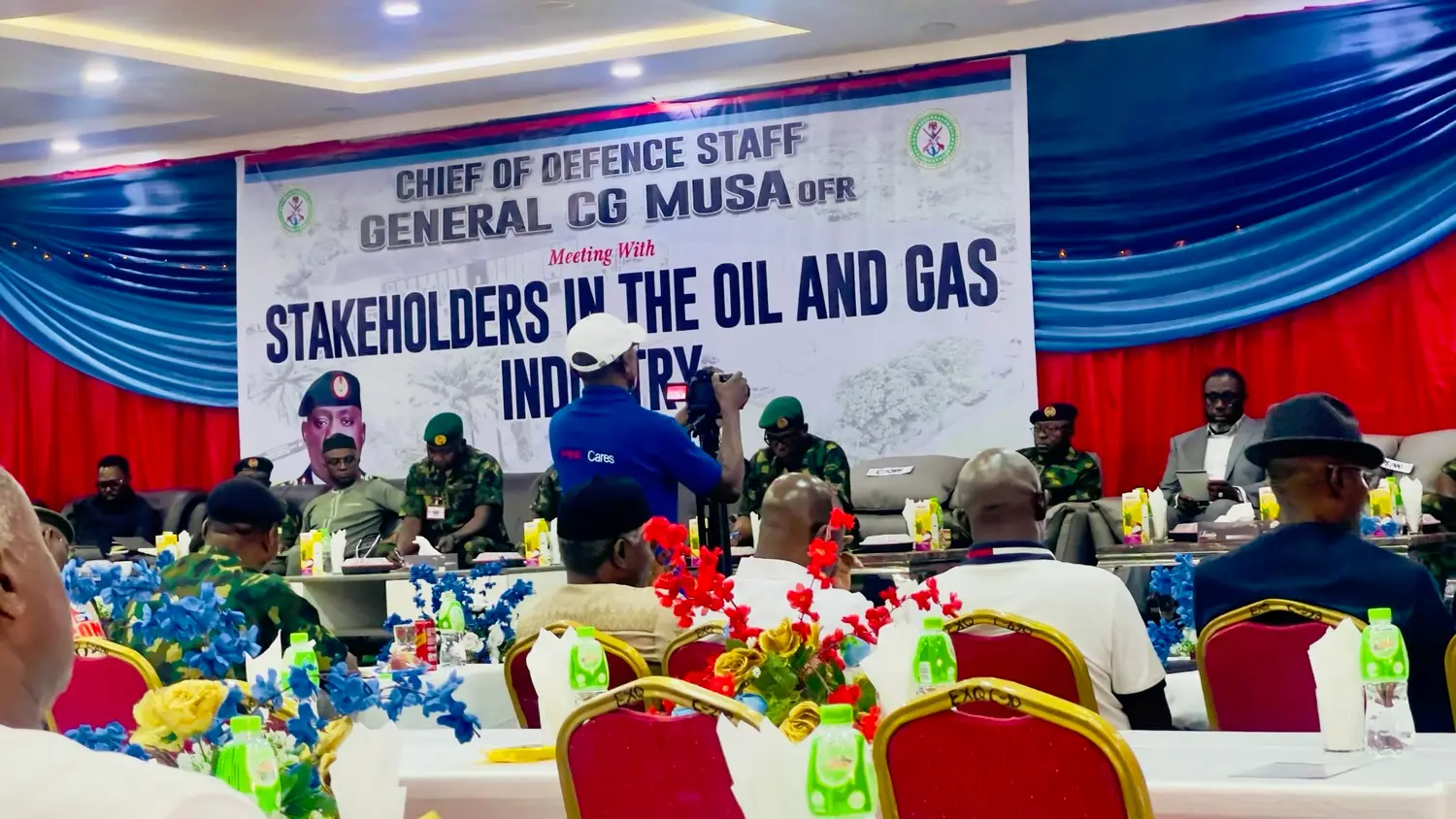
A detailed analytical report on Chief of Defence Staff General CG Musa February 4 speech at the Oil and Gas Stakeholders’ Meeting, examining Nigeria’s ambitious drive to boost oil production and the strategic imperatives for national security and economic progress.
PORT HARCOURT, Nigeria — In a stirring address delivered on 4 February 2025, Chief of Defence Staff General CG Musa outlined an ambitious vision to propel Nigeria’s oil production towards a new era of economic prosperity and security.

Speaking at the Oil and Gas Stakeholders’ Meeting, the General’s remarks not only celebrated recent milestones but also issued a critical challenge: to overcome persistent obstacles and realise a production target of 2.2 million barrels per day (BPD).
This report provides a comprehensive analysis of his speech, its implications for national security, and the broader context of Nigeria’s energy sector transformation.
Setting the Scene: A Strategic Convergence
General Musa opened his address by expressing profound gratitude to all present stakeholders, highlighting the meeting as a pivotal forum for dialogue between key players in the oil and gas industry.
The Defence Headquarters’ decision to convene such a meeting underscores the recognition that the sector is not merely an economic engine, but a strategic pillar that underpins national security and socio-economic stability.
The Role of Stakeholder Engagement
The General stressed the necessity for honest, objective discussions about the challenges facing the industry. His call for candid engagement is a clarion call for transparency and collective problem-solving.
In an environment where fragmented interests often impede progress, the emphasis on synergy between government, industry, and local communities is both timely and critical.
A Testament to Resilience: From Setbacks to Progress
Historically, Nigeria’s oil production has been hampered by a myriad of challenges—from infrastructural deficiencies to socio-political unrest. General Musa recalled how past impediments had severe repercussions on the national economy, thereby framing the recent improvement in production output as a hard-won victory.
Today, with an output exceeding 1.8 million BPD, Nigeria stands at a crossroads, poised to meet—and perhaps exceed—the ambitious directives set by President Bola Ahmed Tinubu.
Recognising the Journey
The General’s acknowledgment of the stakeholders’ unwavering commitment serves as both commendation and a reminder of the collaborative spirit required to drive national progress. Yet, he was unambiguous: while significant strides have been made, the path ahead is fraught with challenges that demand even greater collective effort.
The directive to achieve 2.2 million BPD is not merely a production target but a strategic imperative that touches on national pride, security, and long-term economic viability.
National Security and Economic Prosperity: Two Sides of the Same Coin
General Musa’s speech transcends the traditional boundaries of an energy sector address. It is a strategic manifesto that interweaves national security concerns with economic development.
The stability of oil production, he argued, is inextricably linked to the security of the Niger Delta—a region that has historically been a flashpoint for unrest due to environmental, economic, and social grievances.
The Security-Energy Nexus
By framing oil production as both an economic lifeline and a security priority, the General highlighted a critical intersection: ensuring that the Niger Delta remains a “beacon of resilience, opportunity, and peace.”
This dual emphasis is reflective of a broader strategic recalibration where energy policy is no longer viewed in isolation but as a fundamental component of national stability.
The integration of defence considerations into the energy dialogue is a stark reminder that sustainable production must be underpinned by robust security measures, effective governance, and community engagement.
The President’s Vision and the Imperative of Unified Action
A significant portion of the address was devoted to acknowledging President Bola Ahmed Tinubu’s leadership. By extending heartfelt gratitude to the Commander-in-Chief of the Armed Forces of Nigeria, General Musa reinforced the message that national progress is the result of unified leadership and collective endeavour.
The President’s directives are portrayed not just as political mandates, but as strategic blueprints aimed at catalysing national development.
The Call for Accountability and Realism
General Musa’s insistence on honest participation from all stakeholders is a call to accountability. He urged participants to critically examine current strategies, assess the effectiveness of ongoing initiatives, and craft pragmatic pathways that reconcile ambition with ground realities.
This approach suggests a departure from overly optimistic projections towards a more realistic, evidence-based roadmap for achieving sustainable oil production growth.


The Niger Delta: A Crucible of Challenges and Opportunities
The Niger Delta remains at the heart of the discourse. Recognised as a region of immense potential and persistent instability, its role in the national oil production narrative is both pivotal and complex.
The General’s address highlighted the importance of leveraging the region’s resources while addressing the socio-economic challenges that have long plagued its communities.
Balancing Economic Exploitation with Social Equity
By explicitly mentioning the “peace loving people of the Niger Delta” and commending local governments for their support, the speech acknowledged the delicate balance required to exploit natural resources while ensuring that the benefits accrue to local populations.
This balancing act is essential for maintaining social cohesion and preventing the recurrence of conflict. The emphasis on the Niger Delta as a model of resilience and opportunity is a strategic narrative designed to foster trust and cooperation between the state and its citizens.
A Critical Analysis: Strengths, Gaps, and Future Prospects
While the General’s speech is replete with commendable calls for unity and accountability, a critical analysis reveals several underlying challenges that must be addressed:
Strengths
Strategic Integration: The linking of national security with oil production is a robust strategic approach that acknowledges the multifaceted nature of the energy sector.
Stakeholder Inclusivity: The invitation for open dialogue and honest assessments sets the stage for more inclusive and realistic policy formulations.
Clear Milestones: The delineation of current achievements (1.8m BPD) and future targets (2.2m BPD) provides measurable goals that can galvanise collective effort.
Gaps and Challenges
Operational Realities: Despite the optimistic tone, the General’s address skirts the complex operational challenges such as ageing infrastructure, environmental degradation, and logistical constraints that continue to hamper production.
Political Will and Governance: The success of the proposed strategies is contingent upon sustained political will and effective governance—a factor that has historically been a stumbling block in Nigeria’s energy sector.
Local Community Engagement: While the speech pays lip service to the importance of the Niger Delta, it does not fully articulate concrete measures to address the deep-rooted grievances that have led to recurrent unrest in the region.
Future Prospects
The road to 2.2 million BPD is fraught with challenges, but the speech indicates a renewed commitment to a collaborative and pragmatic approach.
Moving forward, it will be imperative for stakeholders to not only invest in technological and infrastructural advancements but also to prioritise social equity and environmental sustainability.
The nexus between defence, security, and energy policy will likely be the defining feature of Nigeria’s efforts to achieve long-term stability and prosperity.
Concluding Observations: A Turning Point in Nigeria’s Energy Policy?
General CG Musa’s address at the Oil and Gas Stakeholders’ Meeting is more than just a ceremonial speech—it is a strategic blueprint for a future where energy production, national security, and economic development are inextricably linked.
His call for honest dialogue, collective action, and relentless pursuit of ambitious targets resonates as both a challenge and an opportunity for all stakeholders.
In a nation where oil is often synonymous with both wealth and conflict, this meeting represents a critical juncture. The outlined strategy, if implemented with transparency and rigour, has the potential to not only transform Nigeria’s energy landscape but also to serve as a model for integrated national development.
As the nation grapples with operational challenges and the complexities of modern energy governance, the success of this ambitious vision will depend on the ability of all stakeholders to rise above parochial interests and work towards a unified, resilient future.
Atlantic Post brings deep insights and rigorous analysis to the intersection of geopolitics, energy policy, and economic development. Drawing on decades of experience and a nuanced understanding of global defence affairs, our correspondents provides in-depth, factual, and critical analysis to keep our readers informed of the latest strategic developments.