Governor Diri praises Gen. Abdussalam for ensuring non-partisan military conduct in Bayelsa’s peaceful 2023 election, setting a new standard for Nigeria’s democracy.
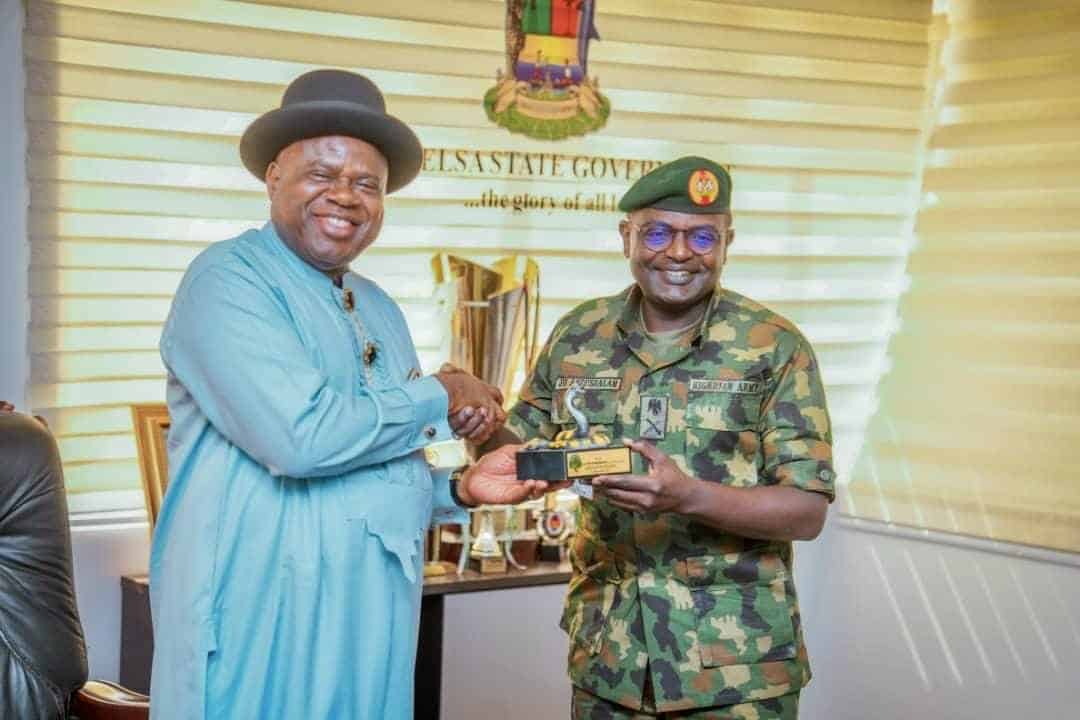
YENAGOA, Bayelsa State — In a significant political development, Bayelsa State Governor, Senator Douye Diri, has lauded the outgoing General Officer Commanding (GOC) 6 Division of the Nigerian Army, Major General Jamal Abdussalam, for his unwavering commitment to neutrality during the November 11, 2023, governorship election in the state. This commendation was made during a courtesy visit by Major General Abdussalam to the Government House in Yenagoa.

Governor Diri praises Gen. Abdussalam for ensuring non-partisan military conduct in Bayelsa’s peaceful 2023 election, setting a new standard for Nigeria’s democracy. Governor Diri praises Gen. Abdussalam for ensuring non-partisan military conduct in Bayelsa’s peaceful 2023 election, setting a new standard for Nigeria’s democracy. Governor Diri praises Gen. Abdussalam for ensuring non-partisan military conduct in Bayelsa’s peaceful 2023 election, setting a new standard for Nigeria’s democracy. Governor Diri praises Gen. Abdussalam for ensuring non-partisan military conduct in Bayelsa’s peaceful 2023 election, setting a new standard for Nigeria’s democracy. 
Governor Diri praises Gen. Abdussalam for ensuring non-partisan military conduct in Bayelsa’s peaceful 2023 election, setting a new standard for Nigeria’s democracy. Governor Diri praises Gen. Abdussalam for ensuring non-partisan military conduct in Bayelsa’s peaceful 2023 election, setting a new standard for Nigeria’s democracy.


Governor Diri’s Commendation
Governor Diri expressed profound appreciation for Major General Abdussalam’s professionalism and the exemplary conduct of the military and other security agencies during the electoral process. He emphasised that the impartial stance adopted by the security forces was instrumental in ensuring a peaceful and credible election.
The governor stated, “On behalf of the state government, I thank you profusely for being a fine officer and a thoroughbred professional. I particularly want to appreciate you and your team of officers for ensuring that you were non-partisan during our 2023 governorship election in the state.”
The Role of Security Agencies in Electoral Processes
The conduct of security agencies during elections is pivotal to the integrity of the electoral process. In Nigeria, the military has often been accused of partisanship, leading to tensions and disputes. However, the 2023 Bayelsa State governorship election presented a departure from this narrative.
The neutrality maintained by the 6 Division under Major General Abdussalam’s leadership set a commendable precedent. This approach not only fostered a peaceful environment but also bolstered public confidence in the electoral system.
Major General Abdussalam’s Tenure and Achievements
Assuming command of the 6 Division in April 2023, Major General Jamal Abdussalam embarked on initiatives aimed at enhancing both operational efficiency and personnel welfare. Notably, he commissioned several welfare projects at the 343 Artillery Regiment in Elele Barracks, Rivers State. These projects included the inauguration of a 200-meter concrete road linking senior non-commissioned officers’ quarters to the medical centre, an indoor sports and recreation centre, a tennis court, and a refurbished squash court. Such developments significantly improved the living conditions of the troops and their families, reflecting the General’s commitment to the well-being of his personnel.
Furthermore, Major General Abdussalam played a crucial role in bolstering Nigeria’s crude oil production. Upon his assumption of office, the country’s production stood at 998,000 barrels per day. By the end of 2023, this figure had risen to 1.88 million barrels per day. This remarkable achievement was attributed to the dismantling of illegal crude oil refineries and a significant reduction in criminal activities within the South-South region, making it one of the safest geopolitical zones in the country.
The Significance of Non-Partisanship in Security Operations
The commendation from Governor Diri underscores the critical importance of non-partisanship among security agencies during elections. The Nigerian Army’s adherence to this principle in Bayelsa State not only ensured a peaceful electoral process but also enhanced its credibility among the populace. Such conduct is essential in a democratic society, where the impartiality of security forces underpins the legitimacy of electoral outcomes.
Looking Ahead: The Legacy of Major General Abdussalam
As Major General Abdussalam transitions to his new role at the Nigerian Army Headquarters, his tenure in the 6 Division leaves an indelible mark. His leadership exemplified a balance between operational effectiveness and personnel welfare, setting a standard for his successor. The governor’s hope that the incoming GOC will continue in this stead reflects the desire for sustained professionalism and neutrality in the state’s security operations.
The commendation of Major General Jamal Abdussalam by Governor Douye Diri highlights a pivotal moment in Bayelsa State’s political and security landscape. It serves as a testament to the positive impact of professional and non-partisan security forces on the democratic process. As Nigeria continues to navigate its democratic journey, such examples offer a blueprint for the role of security agencies in fostering peace, stability, and credible elections.
The Role of Security Forces in Strengthening Democratic Institutions
In democracies, security agencies are indispensable for safeguarding the electoral process. Their neutrality is not just a constitutional requirement but also a moral obligation to ensure that elections reflect the will of the people. When security forces lean toward partisanship, they risk undermining democracy itself, sowing seeds of discord, and delegitimising electoral outcomes. The commendation of Major General Abdussalam’s conduct during the 2023 Bayelsa State governorship election underscores a turning point in redefining the relationship between security forces and democratic governance.
The Nigerian Army, often at the centre of electoral controversies in the past, has faced accusations of partisan involvement in elections. These allegations, ranging from voter intimidation to direct interference in polling activities, have eroded public trust in the institution’s neutrality. The 2023 Bayelsa election, however, demonstrated a rare exception where professionalism and adherence to democratic principles took precedence over political pressures.
Governor Diri’s acknowledgment of Major General Abdussalam’s impartiality serves as a beacon of hope for a nation grappling with electoral credibility. This moment is an opportunity for policymakers to institutionalise frameworks that reinforce such neutrality across all levels of security operations. This includes robust oversight mechanisms, comprehensive training on human rights and electoral conduct, and the establishment of clear punitive measures for breaches of neutrality.
The Nexus Between Security and Credible Elections
Security plays a dual role in elections: ensuring the safety of voters and officials while simultaneously deterring criminal or disruptive activities. This duality places enormous responsibility on security agencies, which must strike a delicate balance between vigilance and non-interference. Bayelsa State’s governorship election exemplified this balance, thanks to the leadership of Major General Abdussalam.
The peaceful conduct of the November 11, 2023, election is a testament to the strategic deployment of resources and personnel by the 6 Division. It also highlights the importance of inter-agency collaboration, with the military working alongside police forces and civil defense units to maintain order. This cooperative approach, when devoid of political undertones, creates an environment conducive to free and fair elections.
However, such success stories remain the exception rather than the norm in Nigeria’s electoral history. Instances of violence, voter suppression, and ballot box snatching have marred previous elections, often linked to the overreach or partisanship of security forces. For this reason, Bayelsa’s 2023 election should be studied as a case study for best practices, providing insights into what worked and how these can be replicated nationwide.
The Economic and Social Dimensions of Security Neutrality
The implications of a peaceful and credible election extend beyond the political sphere, influencing both economic stability and social cohesion. Bayelsa State, situated in the volatile Niger Delta region, has long been a flashpoint for election-related violence. The neutral conduct of the 6 Division under Major General Abdussalam’s leadership not only prevented potential unrest but also preserved the state’s economic interests.
Bayelsa, as an oil-producing state, is critical to Nigeria’s revenue generation. Election-related disruptions could have jeopardised oil production, further exacerbating the country’s economic challenges. By ensuring a peaceful election, security agencies indirectly supported the stability of oil exploration and production activities. This underscores the broader economic implications of their neutrality, as political instability often translates to economic stagnation.
On a social level, the absence of violence during the election fostered a sense of trust and unity among the populace. Communities previously divided along political lines were able to participate in the electoral process without fear, reinforcing the social fabric of the state. This peace dividend, though intangible, is invaluable in a region historically plagued by tensions and mistrust.
Governor Diri’s Call for Continuity and Institutional Memory
While Governor Diri’s commendation of Major General Abdussalam is well-deserved, it also raises critical questions about continuity. The governor’s plea for the incoming GOC to emulate his predecessor’s professionalism reflects a broader concern about the lack of institutional memory within Nigeria’s security agencies. Leadership changes often disrupt ongoing initiatives, leaving gaps that can undermine progress.
To address this, there is a need for institutional reforms that prioritise continuity. This includes documenting best practices, creating comprehensive handover notes, and establishing mentorship programs where outgoing officers guide their successors. Such measures would ensure that the gains achieved under Major General Abdussalam’s tenure are not lost but built upon.
Policy Recommendations for Scaling Neutrality Nationwide
The success of the 6 Division in Bayelsa State should not remain an isolated achievement. It is imperative for Nigeria to scale this model of neutrality across all electoral zones. This requires a multi-faceted approach, including:
- Legislative Oversight: Strengthening the legal framework governing the conduct of security agencies during elections to deter partisanship.
- Capacity Building: Implementing regular training programs on electoral laws, human rights, and conflict resolution for security personnel.
- Community Engagement: Encouraging dialogue between security agencies and local communities to build trust and dispel fears of intimidation.
- Independent Monitoring: Establishing third-party oversight committees to monitor the conduct of security forces during elections.
A New Dawn for Electoral Integrity
The conduct of the 6 Division during the 2023 Bayelsa State governorship election represents a watershed moment in Nigeria’s electoral journey. It demonstrates that with the right leadership and commitment to democratic principles, security agencies can play a pivotal role in safeguarding the integrity of elections.
Governor Douye Diri’s commendation of Major General Abdussalam is not merely a recognition of individual excellence but a call to action for systemic change. By institutionalising the lessons learned from Bayelsa, Nigeria can move closer to realising the ideal of free, fair, and credible elections—a cornerstone of any thriving democracy.
Additional report by: Kalada Jumbo
Atlantic Post national Politics Reporter