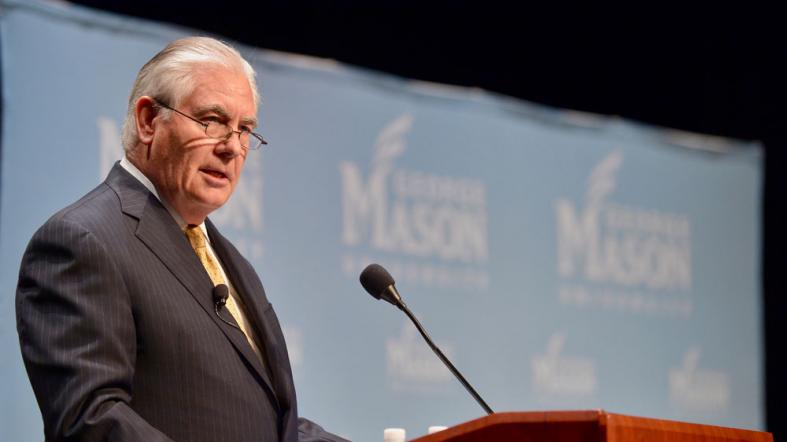

Just hours before embarking on his first official visit to Sub-Saharan Africa, Secretary Tillerson today, delivered remarks about the United States relationship with Africa.
Secretary Tillerson underscored that the United States’ security and economic prosperity are linked with Africa’s like never before and said, “As we look ahead, this Administration seeks to deepen our partnerships in Africa, with an aim of making African countries more resilient and more self-sufficient.”
Secretary Tillerson emphasized that a stable future is dependent on security. The Secretary discussed the growing threat of terrorism, saying “To prevail against such evil forces, the United States has committed to working with African partners to rid the continent and the world of terrorism by addressing drivers of conflict that lead to radicalization and recruitment in the first place, and building the institutional law enforcement capacity of African nations. We want to help African states provide security for their citizens in a lawful manner.”
Secretary Tillerson said that in addition to supporting important security efforts, we must work to find long-term diplomatic solutions to conflicts that cause so much human suffering. He stated, “Until we do, the United States, as the world’s single-largest provider of humanitarian assistance, will continue to stand with the most vulnerable.”
In his remarks, the Secretary also called on African countries to take a more active role on the global stage. He stated, “One area where we seek greater cooperation is our peaceful pressure campaign to bring the DPRK to the negotiating table.”
The Secretary continued, “The DPRK threatens the entire global community through its unlawful nuclear and ballistic missile programs and proliferation activities, including its arms exports to Africa. It doesn’t just involve our allies in Europe or Asia. It doesn’t just include countries with longstanding ties to the DPRK like China and Russia. This is and must be a global effort.”
Secretary Tillerson emphasized that greater security on the continent is a prerequisite for greater prosperity. “Greater stability will attract greater United States’ trade and investment with African nations, leading to further development, building on what we have accomplished through the African Growth and Opportunity Act, or AGOA,” he said.
Secretary Tillerson continued, “The United States is eager to reduce barriers to trade and investment with our African partners, helping African countries transition from dependency toward self-sufficiency; growing their middle class; and better integrating African economies with the rest of the world.”
Citing Africa’s expanding youth population, the Secretary underscored the need to invest in an educated and healthy workforce to prepare for the future and realize the continent’s potential. Secretary Tillerson pointed to the Young African Leaders Initiative (YALI) as one example of how the State Department and USAID are investing in the next generation of African leaders.
The Secretary also highlighted the United States’ work to transform the global HIV/AIDS response through the Presidents Emergency Plan for AIDS Releief (PEPFAR). The Secretary discussed progress over the last 15 years through PEPFAR and looked to the future.
Secretary Tillerson discussed this administraton’s commitment to saving lives and to helping Africa reach an AIDS free future. He stated, “Last September, I announced the PEPFAR Strategy for Accelerating HIV/AIDS Epidemic Control for 2017-2020. The strategy is a roadmap to achieve epidemic control in more than 50 countries over the next three years. It outlines a path to accelerate our work in 12 high-HIV-burden countries in Africa poised to achieve epidemic control by 2020. We can actually see a future free of HIV/AIDS. It is just ahead of us. That’s critical to Africa’s future.”
Secretary Tillerson underscored the importance of democratic governance. “For security, trade and investment, and economic development to sustain itself requires effective and accountable government institutions that earn the trust and support of the people. Peace and prosperity are only possible in a democratic society,” he said.
The Secretary continued, “Media freedom, open communication, religious freedom, and a vibrant civil society foster creativity, ideas, energy, and economic growth. Today Africa has much to gain by creating stronger, more transparent democratic institutions that reflect their citizens’ voices, reject corruption, and protect and promote human rights.”
The Secretary reaffirmed that the United States will continue its work with African countries to strengthen their democratic institutions through democracy, human rights, and governance programs to create more transparent, less corrupt institutions that value consensus-building over conflict.
As he closed, the Secretary looked to the future of the United States’ relationships across Africa with optimism.
“The United States sees a bright future in Africa. We have an opportunity to be a part of Africa’s journey to a stable, prosperous future for its people. Each of these priorities – trade and investment, good governance, respect for human rights, combating terrorism and instability – have the same guiding principle in mind: to help African countries build the capacity to take care of their people.”
-Secretary Tillerson
Secretary Tillerson concluded by acknowledging that although there are no quick fixes to the challenges we face, the United States is committed to meeting them in partnership with the nations of Africa for a more prosperous future. (DipNote Bloggers)