By Editor
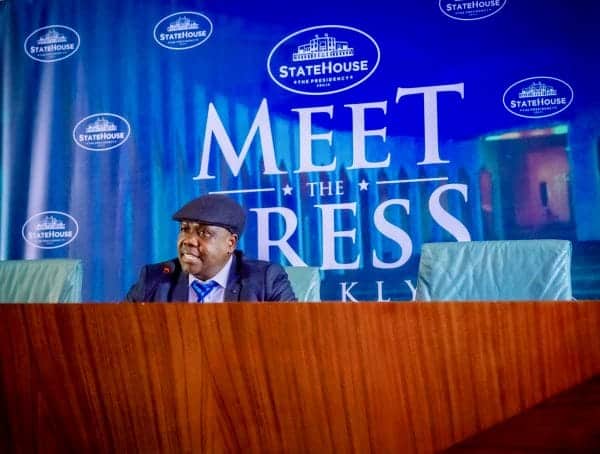
ABUJA, Nigeria — In a nation where media interactions often shape public perception and government accountability, the recent remarks by Daniel Bwala, newly appointed Special Adviser on Policy Communication to President Bola Tinubu, have ignited widespread debate. Bwala’s pledge to foster synergy within the State House Press Corps, combined with his commitment to advancing the President’s agenda, has drawn both praise and skepticism from various quarters.


Bwala’s statement, shared via X (formerly Twitter), emphasised his dedication to working harmoniously with the press corps while ensuring unwavering loyalty to President Tinubu. He assured Nigerians of his intent to lead a collaborative team effort to project and defend the President’s policies. However, these assurances are being scrutinised in light of Nigeria’s political climate, where media narratives have often been accused of being manipulated to shield leadership from public accountability.
The context of Bwala’s declaration underscores a critical juncture in the Tinubu administration’s evolving media strategy. Coming into power amid controversies surrounding his election victory and mounting economic challenges, Tinubu faces a herculean task in convincing Nigerians of his administration’s capacity for change. The appointment of Bwala, a seasoned lawyer and media strategist, is seen as a calculated move to reshape the public narrative. However, the sincerity of his “synergy without fear or favour” approach is being questioned by skeptics who fear that press independence may be compromised under his watch.
The Politics of Media Synergy in a Democratic Setting
Daniel Bwala’s call for synergy reflects an understanding of the media’s critical role in governance. The relationship between the State House Press Corps and the presidency is vital for disseminating information, shaping national discourse, and holding leaders accountable. However, critics argue that Bwala’s phrasing raises concerns about the balance between fostering cooperation and ensuring journalistic independence. Will his promise of synergy translate into greater transparency, or will it be a euphemism for tightly controlled narratives?
In Nigeria’s political landscape, where the line between press freedom and propaganda is often blurred, the role of a media adviser is as much about perception management as it is about communication. Bwala’s emphasis on advancing Tinubu’s agenda without explicitly addressing concerns of transparency has drawn ire from media watchdogs. Observers note that a failure to guarantee press autonomy could alienate the very stakeholders needed to bolster public confidence in the administration.
Moreover, Bwala’s statement raises questions about the extent to which press corps members can operate without fear or favour. Journalists in Nigeria often face intimidation, harassment, and censorship when reporting on sensitive political issues. Bwala’s reassurances, while laudable on the surface, are viewed with suspicion by those who see them as mere platitudes designed to placate critics.
Unpacking the Role of Presidential Media Advisers in Crisis Communication
The appointment of Bwala comes at a critical time for the Tinubu administration, which has been grappling with public discontent over subsidy removal, inflation, and unemployment. In such a volatile political climate, the role of the media adviser transcends the mere articulation of government policies. It becomes a tool for managing public perception, especially when controversies threaten to erode the President’s credibility.
Bwala’s track record as a lawyer and political commentator suggests he is no stranger to public discourse. His strategic positioning as the President’s spokesperson signals Tinubu’s intent to consolidate his media operations and establish a unified narrative. However, this centralisation could backfire if perceived as an attempt to muzzle dissent or suppress critical voices within the media. Analysts caution that for Bwala to succeed, he must balance loyalty to the President with a commitment to upholding democratic principles, including press freedom.
The concept of “advancing the cause of our principal,” as articulated by Bwala, has also sparked concerns about prioritising the President’s image over the citizenry’s needs. Critics argue that the government’s media strategy should focus on addressing public grievances and fostering dialogue rather than solely projecting the President’s agenda. A failure to strike this balance could deepen public mistrust in an administration already perceived as detached from grassroots realities.
A New Media Era or Business as Usual?
The stakes are particularly high for Daniel Bwala, whose role requires navigating the complexities of a media landscape rife with political biases and competing interests. His pledge to work without fear or favour will be tested by how he handles controversial issues, such as allegations of electoral malpractice, corruption, and policy failures. Nigerians will be watching closely to see whether his tenure marks a shift towards openness and accountability or merely a continuation of past practices.
Moreover, Bwala’s appointment reflects a broader trend in Nigerian politics, where media strategists are increasingly viewed as pivotal players in governance. The Tinubu administration’s focus on media control highlights the recognition of public opinion as a powerful force. However, the effectiveness of this approach depends on whether it fosters genuine engagement with citizens or simply reinforces existing power structures.
As public discourse intensifies, many are calling for the Tinubu administration to prioritise transparency in its media engagements. The credibility of the presidency hinges on its willingness to allow the press corps to operate independently while providing accurate and timely information to the public. Anything less would undermine Bwala’s lofty promises and cast a shadow over his tenure.
Examining the Legacy of Presidential Media Strategies and Bwala’s Potential Impact
Nigeria’s history of presidential media strategies is riddled with controversy, highlighting the delicate interplay between political power and public perception. From the military regimes of the past to the democratically elected administrations of recent decades, the role of media advisers has often been contentious. The appointment of Daniel Bwala as Special Adviser on Media and Communications to President Bola Ahmed Tinubu must be understood within this broader historical and political context.
A Legacy of Mistrust and Manipulation
The Nigerian presidency has long relied on media strategists to craft narratives that shield leaders from criticism and bolster their legitimacy. During the military era, press censorship was overt, with dissenting voices silenced through draconian measures. Under democratic rule, the methods have become subtler, with the government leveraging access to information, selective interviews, and state-sponsored media campaigns to control narratives.
Bwala steps into this role at a time when the media is increasingly fragmented, with the rise of digital platforms providing alternative channels for information dissemination. This democratisation of media poses both opportunities and challenges for the Tinubu administration. On the one hand, it allows the government to directly engage with citizens. On the other, it exposes officials to unfiltered criticism and counter-narratives that can quickly gain traction.
Critics argue that Bwala’s pledge of synergy within the State House Press Corps could be a veiled attempt to co-opt journalists into the government’s messaging apparatus. While fostering cooperation is essential for effective communication, it must not come at the expense of press independence. Observers caution that any perceived manipulation of the press could erode public trust in both the media and the presidency.
Bwala’s Professional Background: A Double-Edged Sword?
Daniel Bwala’s background as a lawyer and political commentator positions him uniquely for his new role. His legal expertise provides him with a keen understanding of the constitutional and ethical dimensions of governance, while his experience as a public speaker equips him to navigate the demands of media engagement. However, these strengths could also be liabilities if they are seen as tools for deflecting accountability or advancing partisan interests.
As a former member of the opposition who once criticised the ruling All Progressives Congress (APC), Bwala’s appointment raises questions about his ideological consistency and loyalty. While some view his shift as a pragmatic embrace of political realities, others see it as opportunistic, casting doubt on his ability to serve as an impartial conduit between the presidency and the public. This perception is critical, as any hint of duplicity could undermine his credibility and, by extension, the administration’s media strategy.
The Fight for Press Freedom in Nigeria’s Democracy
One of the most pressing issues surrounding Bwala’s appointment is its potential impact on press freedom in Nigeria. Over the years, journalists have faced various forms of repression, from outright violence to legal intimidation. The promise of synergy, as articulated by Bwala, will be meaningless if it does not address these systemic challenges. For the press corps to operate without fear or favour, the government must create an enabling environment that protects journalists from harassment and ensures access to information.
Civil society groups and international organisations have called on the Tinubu administration to prioritise media reforms that promote transparency and accountability. This includes repealing outdated defamation laws, ensuring the independence of regulatory bodies, and fostering a culture of openness within government institutions. Bwala, as the President’s spokesperson, has a unique opportunity to champion these reforms and set a new standard for media engagement in Nigeria.
Advancing Tinubu’s Agenda: The Fine Line Between Advocacy and Propaganda
Bwala’s stated mission to “advance the cause” of President Tinubu underscores a fundamental tension in his role. While it is natural for a media adviser to advocate for the administration’s policies, this must not devolve into propaganda. The distinction lies in the transparency and factual accuracy of the information provided. Nigerians, weary of political spin, are demanding more substance and less rhetoric from their leaders.
The Tinubu administration faces an uphill battle in convincing citizens of its commitment to meaningful change. Policies such as subsidy removal and exchange rate unification, while necessary for economic stability, have inflicted significant hardship on ordinary Nigerians. Bwala’s task is to communicate these policies in a manner that acknowledges their immediate impact while highlighting their long-term benefits. This requires a level of candour and empathy that has often been lacking in Nigerian political discourse.
However, there is a risk that Bwala’s efforts could be undermined by the administration’s broader actions. For instance, if the government continues to prioritise elite interests over grassroots concerns, no amount of media strategy will repair its image. Bwala’s success, therefore, is intrinsically tied to the administration’s ability to deliver tangible results.
The Way Forward: Balancing Media Strategy and Governance
As Daniel Bwala settles into his role, the stakes for Nigeria’s democracy could not be higher. His tenure will be judged not only by his ability to articulate the President’s vision but also by his commitment to upholding democratic principles. The media’s role as a watchdog cannot be overstated, and any attempt to stifle its independence would be a betrayal of the very ideals that the Tinubu administration claims to uphold.
Moving forward, Bwala must prioritise building trust between the government and the media. This includes regular and transparent briefings, addressing journalists’ concerns, and ensuring that critical voices are not silenced. Additionally, he must leverage his position to advocate for broader media reforms that strengthen Nigeria’s democratic institutions.
In conclusion, Daniel Bwala’s appointment as Special Adviser on Media and Communications to President Bola Ahmed Tinubu represents both a challenge and an opportunity. While his professional background equips him for the task, the inherent tensions of his role demand a delicate balancing act. Nigerians will be watching closely to see whether he can deliver on his promises of synergy and accountability or whether his tenure will be remembered as yet another chapter in the long saga of compromised media independence in Nigeria.
As the Tinubu administration navigates the complexities of governance, Bwala’s ability to foster genuine dialogue between the presidency and the public will be a litmus test for its commitment to transparency and reform. The coming months will reveal whether this new era of media engagement heralds meaningful change or merely reinforces the status quo.



