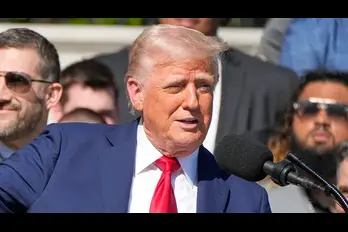
In a historic display of party unity and procedural brinkmanship, the United States Senate late Tuesday approved President Donald Trump’s so‑dubbed “big, beautiful bill” after a tumultuous “vote‑a‑rama” marathon that tested the limits of parliamentary endurance.
Virtually every Republican – save Senators Thom Tillis (R‑N.C.), Rand Paul (R‑Ky.) and Susan Collins (R‑Maine) – rallied behind the mammoth package, which bundles Trump’s 2017 Tax Cuts and Jobs Act extensions with deep spending cuts and record levels of Pentagon funding.
With the partisan divide sharper than ever, Democrats slammed the measure as a grotesque giveaway to the wealthy that will eviscerate Medicaid and send America’s deficit soaring.
A Procedural Spectacle
From Saturday’s procedural vote to proceed through Monday night’s relentless amendment votes, Senate Minority Leader Chuck Schumer (D‑N.Y.) employed every delaying tactic at his disposal: extended speeches, theatrical gallery protests and tactical amendments aimed at exposing fractures in GOP ranks.
Yet time and again, Republicans rebuffed Democratic efforts to shelve the legislation.
Ultimately, it fell to Vice President J.D. Vance to cast the tie‑breaking vote that sent the measure across the line – a stark reminder of how narrow the Republican majority truly is.
“Sweeteners,” Holdouts and Final‑Hour Horse‑Trading
Senate leadership invested heavily in securing the support of wavering moderates.
In a last‑minute “wraparound” amendment, they doubled the rural hospital fund to $50 billion at Senator Collins’s behest, and delayed the start date for SNAP work requirements in high‑error‑rate states such as Alaska to placate Senator Lisa Murkowski (R‑Alaska).
Nonetheless, Collins and Senators Tillis and Paul remained unconvinced, leaving the bill’s passage hinging on razor‑thin margins.
A Staggering Price Tag
The non‑partisan Congressional Budget Office released two sets of projections over the weekend: under “current policy” assumptions, the bill would add roughly $507 billion to deficits over the next decade; under “current law,” in which automatic spending cuts are enforced, it would swell the debt by about $3.3 trillion.
While Senate Republicans insist the package “turbocharges” the economy and prevents the sunset of Trump’s 2017 tax cuts, critics warn it represents a historic dereliction of fiscal responsibility.
Defence Spending Soars to Unprecedented Heights
Embedded within the bill is a gargantuan provision to bolster the Pentagon budget – nearly $850 billion for fiscal year 2025 – solidifying America’s military dominance and topping global peers by a wide margin.
In fact, U.S. defence outlays in 2024 alone reached an estimated $997 billion – more than the next nine countries combined.
Senate Majority Leader John Thune (R‑S.D.) derided Democratic objections as hypocritical: “Democrats are always willing to cut defence, but never want to cut anywhere else.”
The Tax‑Cut Boost: Myth or Reality?
Republicans hail the permanent extension of the 2017 Tax Cuts and Jobs Act (TCJA) as an economic catalyst.
Indeed, GDP growth ticked up by roughly 0.5 percentage points in 2018 compared to the year prior, and Federal Reserve estimates attribute a 1 percentage‑point boost to the 2017 tax cuts in 2018 alone.
Yet sceptics argue that much of the growth stemmed from accommodative monetary policy, and that corporate windfalls disproportionately favoured the wealthiest households, exacerbating inequality.
Medicaid and SNAP Under the Knife
Perhaps the most controversial elements target social safety nets.
Provisions would strip millions of low‑income Americans from Medicaid rolls by imposing work requirements and tightening eligibility, while reviving an earlier proposal to boot undocumented immigrants from the programme entirely.
Simultaneously, the bill scales back Supplemental Nutrition Assistance Program (SNAP) benefits by reinstating stringent work rules in error‑prone states – a move opponents say will deepen food insecurity in vulnerable communities.
House Conservatives Brace for a Fight
As the bill advances to the House, fiscal hawks in the Freedom Caucus decry what they view as “shallow” spending cuts, while moderates fret over the Medicaid rollback.
Speaker Mike Johnson (R‑La.) has publicly urged the Senate to leave the text “as is,” mindful that any changes could imperil final passage.
Yet key House committee chairs, including Ways and Means Chair Jason Smith (R‑Mo.), have warned that the measure must strike the right balance of tax relief and spending restraint to clear the House floor by July 4.
Partisan Entrenchment or Pragmatic Compromise?
For Republicans, the bill symbolises a bold legislative feat: extending tax cuts, fortifying national defence and delivering on immigration‑related priorities in one sweeping package.
To Democrats, it is a cynical ploy to reward corporate donors and starve social programmes, all while presiding over a ballooning deficit.
The divergent narratives underscore a broader ideological chasm: Is deep spending cuts to non‑defence programmes prudent discipline, or reckless austerity?
Outlook: A Precarious Path Forward
Regardless of the House’s disposition, Senate Republicans have signalled an unyielding timeline, aiming to deliver the package to Trump’s desk by Friday.
Should the House balk, the legislative drama will surely intensify, potentially jeopardising the administration’s marquee achievements.
But if the measure prevails, it will stand as one of the most consequential and polarising laws of the Trump era – reshaping America’s tax landscape, social safety net and defence posture for years to come.
—
Key Facts at a Glance
- CBO Deficit Impact: +$507 billion (current policy) vs. +$3.3 trillion (current law)
- Defence Budget FY 2025: $849.8 billion
- US Defence Spending 2024: $997 billion (40% of global total)
- 2018 GDP Growth Bump: +0.5 pp vs. 2017; +1 pp attributable to TCJA
The Atlantic Post will continue to monitor developments as the bill navigates the House gauntlet and, ultimately, reaches the presidential pen.
Stay tuned for our in‑depth analysis of potential amendments, state‑level repercussions and long‑term impacts on Nigeria’s economy as U.S. fiscal policy once again takes centre stage on the world stage.