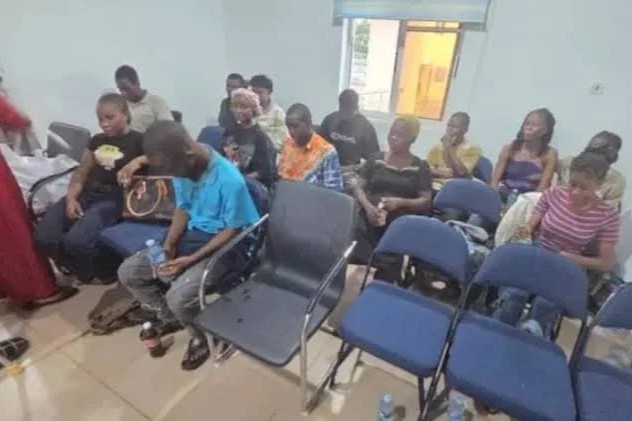
ZARIA — Kaduna State’s hard‑nosed security offensive this weekend marks the most intensive police operation seen in the metropolis for months.
In coordinated raids across notorious black spots — Rigasa, Kawo, Tudun Wada and Sabon Tasha — Divisional Police Officers rounded up 182 suspected criminals and recovered a cache of dangerous weapons and narcotics.
The bust, announced by DSP Mansir Hassan on Saturday, included one AK‑47 rifle magazine loaded with 31 live rounds, 30 bags and some 1,600 wraps of dried leaves alleged to be Indian hemp, and a stolen Honda Accord found in Zaria.
This “reset” of Kaduna’s security landscape comes amid a wider surge in violent crime across North‑West Nigeria.
Between January and June 2024, Kaduna recorded the second‑highest number of kidnapping cases in the region, trailing only Zamfara State; abductions peak in March, June and September, according to a Spatial Dynamics study by the International Journal of Scientific Research in Agriculture.
Meanwhile, joint data project the North‑West to see over 1,300 violent events and nearly 4,000 fatalities in 2024, eclipsing violence figures from 2022.
This operation underlines Command’s zero‑tolerance stance on criminality, yet it also raises questions about sustainable security solutions.
Kaduna’s porous urban‑rural interface and the prevalence of local vigilante groups have long complicated law enforcement.
Just last month, a separate Kawo‑area raid netted 27 suspects and recovered knives, axes, cutlasses and illicit drugs, prompting assurances from CP Rabiu Muhammad that “miscreants will find no haven in Kaduna”.
The recovery of a magazine from an assault rifle in Rafin Guza — reportedly dropped by fleeing suspects — speaks to the ever‑looming threat of armed gangs, known locally as “bandits.”
These groups have frequently terrorised communities along the Abuja‑Kaduna expressway, and were implicated in the mass abduction of more than 200 schoolchildren in Kuriga in March 2024.
Such events underscore the potential for escalation when small criminal cells wield military‑grade weaponry.
Yet, with 182 arrests conducted in a single weekend, some critics suggest the operation is a short‑term fix rather than a long‑term remedy.
Kaduna’s Bureau of Statistics reports that, despite improved odds of conviction, reported property offences remain stubbornly high, and drug‑related crimes account for nearly 70% of police arrests.
Observers urge a two‑pronged approach: relentless enforcement coupled with community engagement to undercut recruitment pipelines.
Suspects Ziya Abdullah and Bashir Usman (“Yellow”), apprehended after attempting to fence a stolen Honda Accord, confessed to wielding knives and cutlasses in violent home raids.
Their testimony lays bare the opportunistic nature of Kaduna’s criminal underworld — where petty theft can quickly spiral into armed robbery and drug trafficking.
Dissecting these networks is crucial if authorities are to prevent recidivism and dismantle organised cells.
DSP Hassan stressed that investigations are ongoing to trace additional culprits, with most detainees slated for arraignment “under the law” once charges are finalised.
However, the backlog of cases in Kaduna’s high courts raises concerns about due process delays. Legal experts warn that unless suspects are swiftly tried, police efforts risk being hollowed out by prolonged pretrial detentions.
Public sentiment in Kaduna appears tentatively supportive. A recent Macrotrends survey shows that nearly 80% of residents perceive crime as “very high,” with 60% citing armed robbery and drug dealing as the most pressing threats.
Trust in police has improved marginally since February, but community leaders insist that transparency and civilian oversight are vital to cement gains.
Looking back, Kaduna’s security profile has oscillated between periods of calm and sudden surges of violence. The infamous February 2021 bandit attacks claimed at least 36 lives, highlighting the state’s vulnerability to coordinated raids.
The current clampdown, if sustained, could mark a decisive pivot away from this cycle — provided it is backed by intelligence‑led policing and robust social interventions.
As Kaduna State enters the home stretch of national elections next year, the success or failure of this operation will carry political as well as social implications.
Commissioner Rabiu Muhammad has urged residents to “remain vigilant” and to report suspicious activity, promising that peace will be upheld.
Yet the ultimate test will be whether these arrests translate into lasting security, rehabilitation of suspects and renewed public confidence in the rule of law.
Additional reporting by Atlantic Post writers Suleiman Adamu & Peter Jene.