Afenifere’s Gamble: Oba Olu Falae’s Elevation and the Resurgence of Restructuring Demands
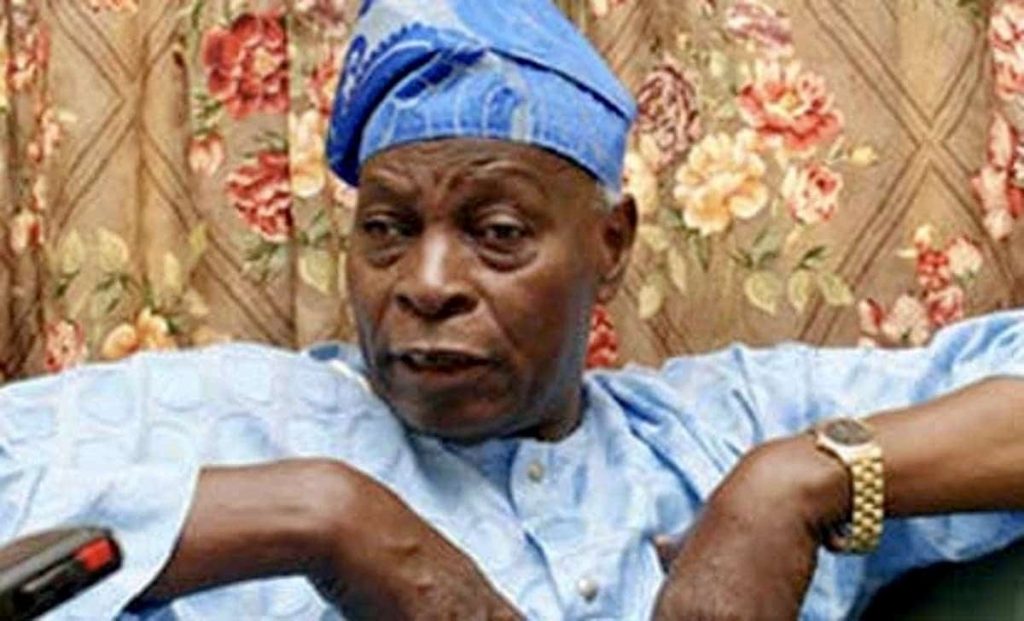
In a move destined to send shockwaves through Nigeria’s faltering federal architecture, the Pan-Yoruba socio-political organisation, Afenifere, has tapped Oba Olu Falae, former Secretary to the Government of the Federation (SGF) and traditional ruler of Ilu Abo, as Chairman of its National Executive Committee (NEC).
Unveiled at a high-stakes caucus in the home of Afenifere’s octogenarian leader, Pa Reuben Fasoranti, the appointment is billed not as a ceremonial elevation but as a clarion call for Afiica’s most populous nation to embrace radical decentralisation—lest it fragments entirely.
A Symbolic Convergence of Tradition and Federal Experience
Oba Falae’s ascendancy at age 86 marries the gravitas of Yoruba chieftaincy with decades of federal-level governance.
Many see this as a deliberate strategy to harness Falae’s deep knowledge of Centre-State dynamics while signalling Afenifere’s determination to reclaim the “House of Oduduwa” as the lodestar for Yoruba identity and political influence.
As National Publicity Secretary Jare Ajayi made clear, Falae’s duties will complement, not clash with, Pa Fasoranti’s stewardship, intensifying Afenifere’s capacity to project a unified Yoruba mandate on matters of national import.
Renewed Urgency on Restructuring: Security, Economy, Federation
The communiqué, painstakingly drafted and read by Jare Ajayi, delivered a withering indictment of Abuja’s centralised apparatus.
Banditry ravages farmlands; kidnapping syndicates breach palace walls; and state-level security initiatives remain fettered by a monolithic police structure.
“We have repeatedly interrogated these national challenges,” the communiqué declared, “and have concluded that restructuring is the most potent remedy.”
In plain terms, Afenifere demands constitutional amendments to devolve policing powers—invoking state-run police forces—and transfer control of forest-guard initiatives to the federating units.
The Real Cost of Centralised Failure: Food Inflation and Transport Woes
Nigeria’s economic scoreboard is grim: headline inflation stands at 24 per cent, with food prices spiking unabated and transport costs soaring, forcing ordinary Nigerians into penury.
Afenifere’s communiqué lamented that “food inflation and transportation costs remain burdensome,” directly linking these hardships to the unwillingness of the federal centre to devolve fiscal and regulatory authority to states.
By tying economic malaise to constitutional paralysis, the group asserts that genuine market reforms and agricultural revival hinge on a leaner, more agile federation.
The National Forest Guards: Decentralisation in Action
Afenifere’s plea extends beyond policing to environmental security. The association insists that Tinubu’s administration permit states to roll out national forest guard schemes, designed to curb illegal logging and armed encroachment.
This proposal dovetails with established conservation models, in which local communities manage and protect their ecosystems—underscoring that ecological stewardship is inseparable from political autonomy.
Security Meltdown: From Royal Palaces to Rural Homesteads
Recent attacks underscore Afenifere’s argument. Oba James Ogunyanda Ilufemiloye, Obalohun of Okoloke in Kogi State, was abducted from his palace; Mr Nelson Adegboyigi was seized from his home in Ondo State and killed even after ransom payment.
Violent incursions in Benue, Plateau and Nassarawa States expose a dangerous truth: the current security architecture is overwhelmed, if not complicit.
Afenifere’s demand for state police is thus not mere posturing but a clarion warning that, without radical reform, Nigeria may dissolve into lawless enclaves.
The National Question Revisited: Historical Roots and Contemporary Impasse
The “National Question”—how Nigeria’s 250 plus ethnic nationalities can cohabit under one constitutional framework—predates independence.
Scholars like E. Ibrahim and I. Nnoli trace its genesis to colonial amalgamation and post-colonial elite competition over resource control and political patronage.
Divergent visions of federation, chief among them resource-owning states versus a revenue-sharing centre, remain unresolved, spawning perennial agitation across the Niger Delta, Middle Belt and the South East.
Afenifere’s Position in the Broader National Discourse
While Afenifere is foremost a Yoruba advocacy group, its restructuring blueprint mirrors demands from other geo-political zones: Niger Delta activists press for genuine resource control; Igbo nationalists agitate for true federalism; Middle Belt groups seek greater representation.
By foregrounding state police, fiscal federalism and devolved forest management, Afenifere stakes a claim to lead a coalition of federating units—potentially reshaping national politics ahead of the 2027 general elections.
Tinubu at Two Years: Challenge or Opportunity?
President Bola Tinubu’s administration has been lauded for pragmatic economic interventions—fuel subsidy removal, tighter monetary policy and rising oil output. Yet, ordinary Nigerians still reel under the twin spectres of insecurity and cost-of-living crises.
Afenifere’s calculated congratulations on Tinubu’s second anniversary came with a stark caveat: make restructuring a third-year priority or risk handing a legacy of fragmentation.
The question now is whether Tinubu, the first Yoruba president in 16 years, will heed calls from his political base or double down on centralised control.
Confronting Complicity and Corruption
Afenifere’s communiqué went further, hinting at complicity within political and security hierarchies that enables endemic lawlessness.
It censured insinuations of collusion at community, military and political levels—an oblique indictment of vested interests who profit from insecurity.
For Afenifere, genuine restructuring must include overhauling security agencies, enforcing accountability and insulating local law enforcement from Abuja’s power broker.
The House of Oduduwa: Back on Track?
National Organising Secretary Abagun Kole Omololu insisted that Falae’s chairmanship will “reinvigorate the organisation” and ensure the “House of Oduduwa is back on track to project the Yoruba mandate.”
Yet, this renaissance entails more than symbolic leadership; it demands hard-nosed political strategy, alliances with other regional blocs and an unwavering push for constitutional reform.
Afenifere’s next steps—lobbying the National Assembly, forging federating-unit coalitions and mobilising grassroots support—will test whether words can translate into tangible change.
Implications for Nigeria’s Future
At stake is nothing less than Nigeria’s survival as a cohesive entity. The “National Question” is not an academic abstraction but a lived reality of millions who bear the brunt of policy failures.
Whether Tinubu opts for incremental devolution or digs in for a final stand on central authority will determine if Nigeria can emerge as a resilient federation or fracture along ethnic and regional lines.
Afenifere’s high-profile power shift and uncompromising stance on restructuring crystallise a moment of truth. The era of hollow federal rhetoric is over; Nigeria’s federating units now insist on genuine autonomy.
For Afenifere—and by extension, the entire country—the question remains: restructure or rupture?
Additional reporting from Taiwo Adebowale, Osaigbovo Okungbowa and Peter Jene