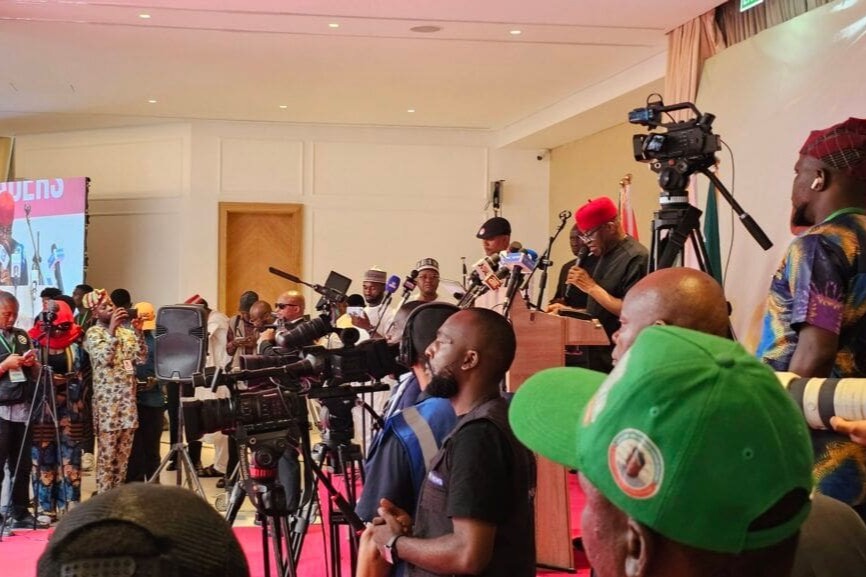
The capture of two senior leaders of Jama’atu Ansarul Muslimina fi-Biladis Sudan (Ansaru), the Al-Qaeda-affiliated group that has plagued the north since 2012, was announced by Nigeria on Saturday, marking what the Office of the National Security Adviser (ONSA) has described as a turning point in the fight against jihadi violence.
According to National Security Advisor Malam Nuhu Ribadu, Mahmud Muhammad Usman, also known as Abu Bara’a, the self-styled “Emir of Ansaru,” and his lieutenant Mahmud al-Nigeri (Mallam Mamuda) were apprehended after an intelligence-led operation that took place between May and July 2025.
Nigerian and foreign media outlets have extensively covered the announcement.
This report unpacks what the arrests mean, what evidence has been seized, how Ansaru’s history and regional ties complicate the threat picture, and why the capture of two senior cadres will neither be the end of the story nor a licence for complacency.
What the government says happened
Ribadu described the effort as months of “deep surveillance, human intelligence and technical tracking” carried out by a coalition of the armed forces, civilian intelligence agencies and other security stakeholders.
He singled out the Kainji National Park area — a patchwork of forest enclaves straddling Niger and Kwara States and reaching towards Benin — as a critical hideout for so-called “Mahmudawa” cells that Mamuda allegedly commanded.
Ribadu added that security forces recovered caches of materials and digital evidence now undergoing forensic analysis, and that the operation “dismantled Ansaru’s central command structure.”
Those are strong words — and they matter. Public confirmation by the NSA transforms rumours into an operational narrative the state can legally and diplomatically act upon.
But it also raises immediate questions about how soon suspects will be charged, how evidence will be preserved and shared with partners, and the risk of retaliatory attacks as Ansaru’s remaining cells react.
Who are Abu Bara’a and Mallam Mamuda?
According to Ribadu’s briefing, Abu Bara’a (Mahmud Muhammad Usman) is accused of coordinating sleeper cells across urban and rural Nigeria and of masterminding kidnappings and robberies used to finance terrorism.
Mamuda, identified as chief of staff and leader of the “Mahmudawa” faction, is said to have trained in Libya between 2013–2015 under foreign jihadist instructors and specialised in weapons handling and improvised explosive device (IED) fabrication.
The NSA links both men to a string of high-profile crimes: the infamous Kuje prison breach, cross-border assaults (including an attack on a Niger uranium facility), the 2013 abduction of French engineer Francis Collomp, the 2019 kidnapping of a traditional ruler (Alhaji Musa Umar Uba, Magajin Garin Daura), and other brutal raids.
Independent background on Ansaru confirms the group’s origins as a 2012 split from Boko Haram, openly aligning with Al-Qaeda in the Islamic Maghreb (AQIM) and rebranding itself as a more selective—but no less lethal—actor.
Ansaru historically portrayed itself as an ideological corrective to Boko Haram’s excesses, but evidence and attacks over the last decade show a group comfortable with kidnapping, targeted assassinations and cross-border crime.
These ties to AQIM alter the strategic calculus: Ansaru is not merely a local criminal band but a node in a trans-Sahara network.
The Kuje prism — why that prison break matters
When security analysts reference the Kuje prison break they point to a dramatic instance of capability projection beyond Ansaru’s usual footprint.
The Kuje incident (widely covered in past analyses of Nigeria’s security environment) highlighted not just operational audacity but also cross-group coordination and intelligence failures.
Observers have long warned that jail-breaks that free extremist cadres are accelerants for future attacks — a fact that makes the alleged involvement of these two men especially consequential.
Regional ripples and the Libya connection
Ribadu’s assertion that Mamuda trained in Libya under instructors from Egypt, Tunisia and Algeria is not novel in an analytic sense — Libya has been a training and transit ground for Sahelian extremists since 2011.
That training pipeline helps explain why cells based in Nigeria’s forests can field IEDs and mount cross-border raids; it also makes Ansaru a regional problem, intersecting with networks in Mali, Niger and Burkina Faso.
The capture of senior cadres therefore has diplomatic and intelligence value beyond our borders: forensic data from seized devices could help map foreign facilitators and funders
The intelligence prize — what forensic analysis could yield
If Nigeria’s security services have indeed seized “digital evidence,” as Ribadu claims, the potential intelligence haul is substantial: contact lists, encrypted messaging threads, transactional records for ransom flows, geolocation metadata, and connections to foreign facilitators.
Properly forensically exploited, these datasets can lead to simultaneous interdictions of logistics networks, bank transfers, and safe-houses.
But the success of such exploitation depends on technical capacity, legal chains of custody, and inter-agency cooperation — in short, the hardest part is rarely the capture; it is what comes after.
Caveats and red flags: what to watch for next
Judicial process: Arrests must be followed by transparent charges and credible prosecutions. Without court evidence, narratives of “decapitation” can be hollowed out by successful defence cases or allegations of due-process failings.
Retaliation risk: History shows that when networks lose leadership they often lash out to demonstrate continuity and relevance. Expect a short-term elevation in kidnappings and ambushes as Ansaru affiliates test security responses.
Residual nodes: The group’s alleged sleeper-cell structure means command removal does not equal mission failure. Cells embedded in towns require sustained HUMINT and community-level policing to root out.
Regional coordination: Forensic evidence must be shared with Niger, Benin, and Sahelian partners to interdict cross-border facilitators; failure to do so weakens the strategic utility of any haul.
Strategic significance — a necessary but insufficient victory
This operation, if substantiated in court and corroborated by independently verifiable evidence, will be one of Nigeria’s most important counter-terror wins since the securitisation escalations of the 2010s.
It demonstrates improved intelligence fusion and inter-service coordination — a capability long demanded by critics of Nigeria’s security architecture.
But the war against violent extremism is not a series of headline-worthy arrests; it is the slow business of dismantling enabling environments: criminal financiers, corrupt local actors, porous borders and the ideological narratives that recruit at the margins.
Final tally: cautious optimism
The capture of Abu Bara’a and Mallam Mamuda should be celebrated as a major operational achievement.
But true victory will be measured in the months and years that follow — by prosecutions that withstand judicial scrutiny, by the forensic dismantling of their networks, by the reduction in kidnappings and attacks, and by evidence that the state is using intelligence to prevent, not merely punish, future crimes.
Nigeria has won a battle. The war for hearts, institutions and secure borders continues.
Follow us on our broadcast channels today!
- WhatsApp: https://whatsapp.com/channel/0029VawZ8TbDDmFT1a1Syg46
- Telegram: https://t.me/atlanticpostchannel
- Facebook: https://www.messenger.com/channel/atlanticpostng