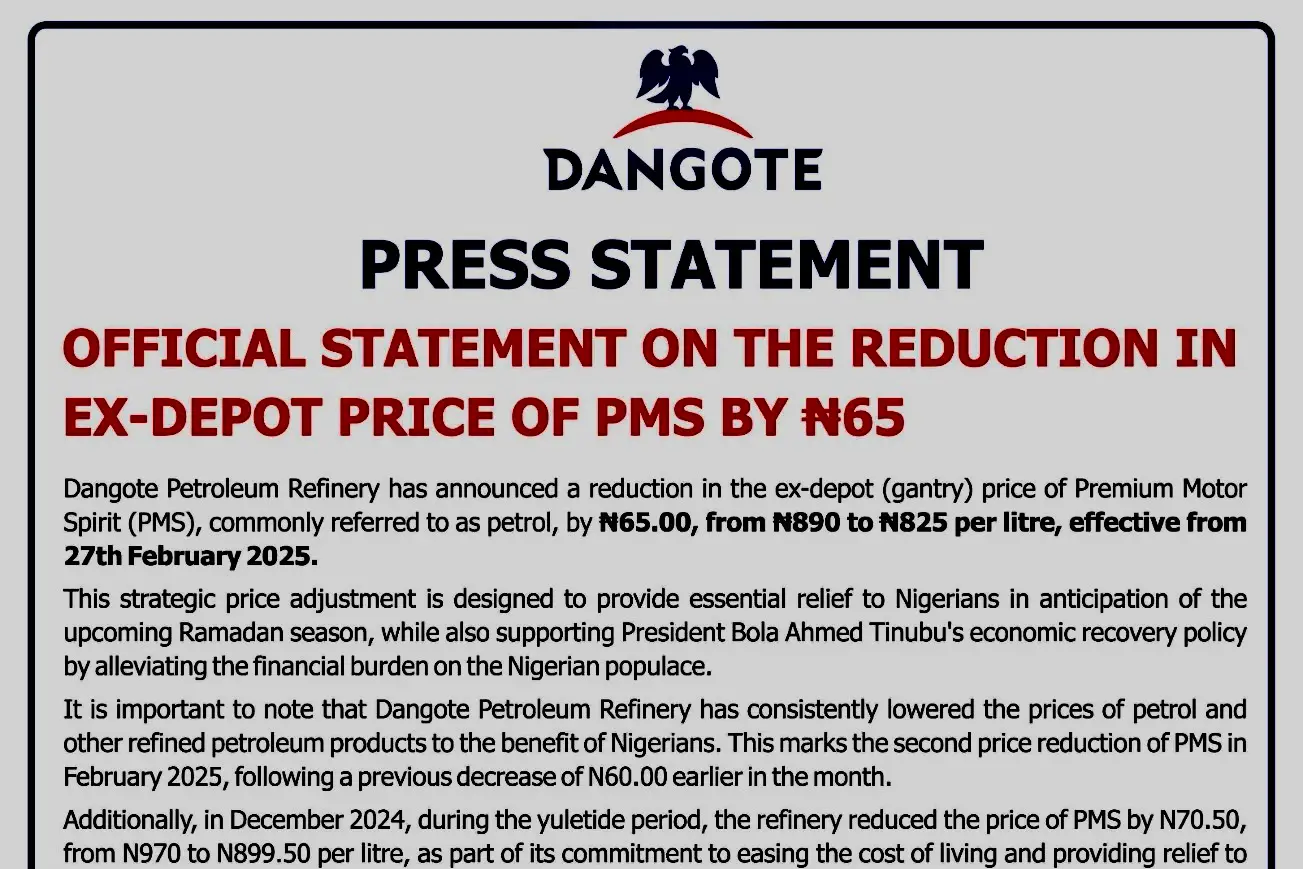
Dangote Petroleum Refinery has reduced the ex-depot price of Premium Motor Spirit (PMS) by N65 to support Nigerians amid rising living costs, especially as Ramadan approaches. This strategic move aligns with President Tinubu’s economic recovery policies, aiming to stabilise the economy by easing consumer burdens and promoting energy self-sufficiency in Nigeria.
LAGOS, Nigeria — In a bold strategic move that is resonating throughout Nigeria’s turbulent fuel market, Dangote Petroleum Refinery has announced a significant reduction in the ex-depot (gantry) price of Premium Motor Spirit (PMS) by N65.00—from N890 to N825 per litre—effective 27th February 2025.
As the nation braces for the spiritually and economically charged Ramadan season, this price adjustment is not merely a market decision; it is a carefully calibrated economic intervention aimed at alleviating the financial burden on everyday Nigerians while dovetailing with President Bola Ahmed Tinubu’s ambitious economic recovery policy.
A New Chapter for Nigeria’s Fuel Pricing Policy
For decades, Nigerians have navigated the volatile seas of fuel pricing, where every kobo has an impact on household budgets and the broader economy.
Today, as the government and industry titans jointly steer the country towards economic rejuvenation, the recent reduction announced by Dangote Petroleum Refinery signals a paradigm shift.
This is the second price drop in February 2025 alone, following an earlier N60.00 reduction, demonstrating a consistent commitment to mitigating the perennial challenge of high fuel costs.
Industry analysts have long argued that such targeted interventions are crucial in a country where fluctuations in fuel prices can trigger widespread economic dislocation.
By lowering the ex-depot price, Dangote is effectively cushioning the consumer against inflationary pressures. This strategic move not only supports the purchasing power of the average Nigerian but also reinforces the broader economic recovery agenda championed by President Tinubu.
Anticipation of Ramadan: Economic Relief for the Masses
The timing of this reduction could not be more critical. As Nigeria gears up for Ramadan, a period marked by increased expenditure on essentials and communal festivities, easing the cost of PMS stands to have a pronounced impact on the cost of living.
The reduction is expected to provide much-needed relief to millions of Nigerians who face daily challenges due to rising living costs.
Fuel, being a primary input in almost every sector—from transportation to manufacturing—has a cascading effect on the overall price structure of goods and services.
By lowering the cost of PMS, the authorities aim to trigger a ripple effect that will reduce the cost of logistics, lower the prices of commodities, and ultimately improve the standard of living.
This move is a testament to Dangote Petroleum Refinery’s longstanding commitment to the welfare of Nigerians, as evidenced by previous price reductions during critical periods, such as the yuletide season in December 2024.
Historical Precedents and the Drive for Consistency
The December 2024 price adjustment, which saw the cost of PMS reduced by N70.50—from N970 to N899.50 per litre—set a benchmark for consumer-friendly pricing policies.
The yuletide reduction played a pivotal role in alleviating seasonal price pressures and ensuring a steady supply of fuel during a time when scarcity and price hikes are typically the norm.
By replicating this approach in February 2025, Dangote Petroleum Refinery is underlining its proactive stance towards consumer welfare and economic stability.
Since its launch, the refinery has earned a reputation for consistently lowering the prices of petroleum products, thus becoming a beacon of hope in an otherwise unpredictable market.
This recent reduction builds on that legacy, cementing the refinery’s role not only as a commercial entity but as a strategic partner in the nation’s quest for economic resilience.
Regional Price Variations: A Closer Look at the Disparities
While the ex-depot price drop is uniform, retail prices vary across different regions, reflecting the diverse economic landscapes within Nigeria.
For instance, at MRS Holdings stations, the product will retail for N860 per litre in Lagos, N870 per litre in the South-West, N880 per litre in the North, and N890 per litre in the South-South and South-East.
Similarly, AP (Ardova Petroleum) and Heyden stations have set their retail prices at N865 per litre in Lagos, N875 per litre in the South-West, N885 per litre in the North, and N895 per litre in the South-South and South-East.
These discrepancies in pricing underscore the complexity of the Nigerian fuel market, where logistics, regional demand, and local economic conditions dictate final consumer costs.
Critics have noted that while the price reduction at the depot level is a positive sign, the variations at retail outlets raise questions about uniform benefit distribution across the country.
Nonetheless, industry insiders argue that such variations are inevitable given the intricate supply chain dynamics and regional economic factors that influence fuel pricing.
Economic Recovery: Aligning with President Tinubu’s Vision
At the heart of this development lies a broader national agenda: the economic recovery policy spearheaded by President Bola Ahmed Tinubu.
His administration has been fervently pursuing policies aimed at revitalising Nigeria’s economy, with a particular emphasis on energy self-sufficiency and enhanced export earnings.
By reducing the price of PMS, the refinery not only eases the immediate financial pressure on consumers but also strengthens the foundations of Tinubu’s economic blueprint.
The government’s vision of making Nigeria self-sufficient in refined petroleum products is a strategic response to years of dependency on imported refined products—a legacy of past policy missteps.
With initiatives like this price reduction, coupled with investments in local refining capacity, the nation is taking significant strides towards realising that vision.
The anticipated surplus for export, as assured by Dangote Petroleum Refinery, could serve as a vital source of foreign exchange earnings, further stabilising the national economy.
Market Reactions and the Path Forward
The announcement has generated a spectrum of reactions from various stakeholders. Consumers, particularly those in the lower-income bracket, have welcomed the reduction with optimism, viewing it as a much-needed respite in the face of escalating living costs.
On the other hand, some market experts remain cautious, arguing that while the price drop is beneficial in the short term, sustained economic recovery will depend on a host of structural reforms within the energy sector.
Moreover, the call for marketers to support this initiative highlights an often-overlooked facet of Nigeria’s fuel industry: the crucial role played by distribution and retail networks.
Ensuring that the benefits of reduced depot prices trickle down effectively to the consumer will require robust cooperation across all levels of the supply chain. Failure to do so could lead to regional disparities and undermine the overarching goal of consumer relief.
The Political and Economic Implications
From a political standpoint, this move is a significant win for the current administration. Fuel prices have historically been a hot-button issue in Nigeria, often sparking public discontent and political unrest.
By addressing this perennial issue head-on, President Tinubu’s government is not only mitigating immediate consumer hardships but also solidifying its position as a responsive and proactive leadership.
Economically, the reduction in PMS prices is set to stimulate a range of positive outcomes. Lower fuel costs are likely to reduce transportation expenses, which in turn could lower the prices of goods and services across the board.
This could lead to a moderation in inflationary pressures, thereby fostering a more stable economic environment conducive to growth and investment.
Conclusion: A Strategic Win for Nigeria
Dangote Petroleum Refinery’s decision to reduce the ex-depot price of PMS by N65.00 is a multifaceted strategy that encapsulates the twin imperatives of consumer welfare and economic recovery.
With Ramadan fast approaching, the timing of this move is critical, offering a timely reprieve to Nigerians burdened by high living costs.
At the same time, it reinforces the broader economic policies of the Tinubu administration, aimed at achieving self-sufficiency in refined petroleum products and positioning Nigeria as a formidable player in the global oil export market.
As the government and industry stakeholders rally together to support this initiative, the eyes of the nation—and indeed the world—will be keenly watching. The success of this price adjustment could set a precedent for future interventions in the fuel market, heralding a new era of strategic, consumer-centric economic policies in Nigeria.
With the combined efforts of policymakers, industry leaders, and marketers, Nigeria is poised to not only weather current economic challenges but also emerge stronger and more resilient on the global stage.
This comprehensive report has delved into the nuances of the recent price reduction, its regional implications, and its strategic alignment with the national economic recovery plan. The analysis underscores the importance of a coordinated approach to fuel pricing—a move that has the potential to transform Nigeria’s economic landscape and deliver lasting benefits to its citizens.
- Additional report by Taiwo Adebowale, Atlantic Post Senior Business Correspondent