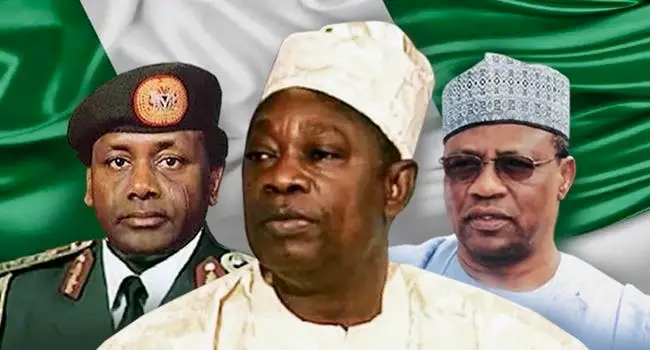
The Abacha family has firmly rejected claims from General Ibrahim Babangida’s memoir, which attributes responsibility for the annulment of Nigeria’s June 12, 1993, presidential election to General Sani Abacha. They argue Babangida’s narrative is a self-serving attempt to evade accountability, emphasising the need for an honest engagement with Nigeria’s historical legacy.
ABUJA, Nigeria — In a stunning salvo that has once again set Nigeria’s political discourse alight, the family of the late General Sani Abacha has forcefully rejected allegations made by former Head of State, General Ibrahim Babangida, in his newly released memoir, A Journey in Service.
The book, which Babangida reluctantly admits marks a regrettable “accident of history” in relation to the annulment of the 12 June 1993 presidential election, now finds itself at the centre of a fierce debate over historical accountability, leadership, and the rewriting of Nigeria’s turbulent democratic legacy.
A Controversial Recounting of History
Babangida’s memoir has not only rekindled old wounds but also sparked fresh controversy in the realm of Nigeria’s political history.
In A Journey in Service, the former military ruler controversially attributed the responsibility for the annulment of the June 12 election—widely believed to have been won by the Social Democratic Party’s (SDP) candidate, MKO Abiola—to military officers under the stewardship of General Sani Abacha.
Babangida alleges that these officers, acting without his express consent, played a decisive role in a decision that has since become synonymous with Nigeria’s ‘lost’ democracy.
However, in a resolute Sunday statement issued from Abuja and signed by his son, Mohammed Abacha, the Abacha family categorically refuted these claims.
They argued that at the time of the infamous annulment, General Sani Abacha was not only out of his depth but was also not the Head of State or the Commander-in-Chief.
“The decision to annul the election was made under the administration of General Ibrahim Babangida, who, as the then Head of State, held absolute executive powers and was solely responsible for the actions of his government,” the statement declared.
This pointed denunciation is a direct challenge to Babangida’s attempt to shift the blame and, arguably, to whitewash history.
The Battle Over ‘Revisionist Narratives’
At the heart of the Abacha family’s objection lies an appeal to the Nigerian public to be cautious of “revisionist narratives”—a term they use to describe attempts to manipulate public perception for personal or political gain. The statement warned:
“We urge Nigerians to be wary of revisionist narratives that seek to manipulate public perception for personal or political reasons. The memory of our late father and leader, General Sani Abacha, must not be tarnished by baseless accusations meant to absolve those who were truly responsible.”
This indictment of Babangida’s narrative suggests that the former head of state’s memoir is not a straightforward recounting of historical events but rather a self-serving document intended to obscure accountability.
The Abacha family’s fierce defence of historical truth is not merely a personal or familial matter—it is a battle for the soul of Nigeria’s collective memory.
The Historical and Political Context
To appreciate the significance of these revelations, one must revisit the legacy of June 12, 1993.
The presidential election of that day is widely regarded as one of the most credible and democratic exercises in Nigerian history.
The victory of MKO Abiola symbolised hope and the promise of genuine democratic change.
Instead, the annulment of the election not only plunged the nation into political turmoil but also sowed seeds of distrust that have haunted Nigeria ever since.
Babangida’s memoir attempts to provide his side of this critical juncture in Nigeria’s evolution.
By labelling the cancellation of the election as an “accident of history” and implicating senior military figures—namely General Sani Abacha—Babangida appears to be distancing himself from the full measure of the decision’s consequences.
Yet, this distancing has not gone unchallenged.
The Abacha family’s response is a vehement rejection of any attempt to dilute Babangida’s responsibility, a stance they have upheld with unwavering vigour over the years.
Accusations of Distortion and Self-Justification
Critics of Babangida’s narrative have long argued that his account of the annulment is a deliberate distortion designed to mitigate his own culpability.
The Abacha family’s statement reinforces this view by asserting that Babangida’s memoir is, in essence, an exercise in self-justification—a historical whitewash that conveniently sidesteps the full ramifications of his actions as Head of State.
As one outspoken public commentator noted, “honesty, sincerity, and integrity are virtues not commonly associated with the author.”
Such criticisms have reverberated across Nigerian media. Prominent news outlets have described Babangida’s account as a “revisionist retelling” that fails to capture the true gravity of Nigeria’s democratic rupture.
It is this perceived failure to engage with the full truth of history that has turned the memoir into a lightning rod for controversy, galvanising both historical purists and political activists alike.
The Wider Implications for Nigeria’s Political Legacy
The repercussions of this controversy extend well beyond the immediate dispute between the Abacha family and Babangida.
At its core, the debate touches on the larger issues of national accountability and the responsibility of political leaders to confront, rather than obscure, their past actions.
Nigeria’s journey towards genuine democratic governance has long been marred by the shadow of military intervention and autocratic rule.
The way in which the events of June 12 are remembered and interpreted is, therefore, not merely an academic exercise—it is central to the country’s ongoing efforts to reconcile with its past.
By challenging Babangida’s account, the Abacha family is not only defending their father’s legacy but also calling on Nigerians to demand a more honest and transparent engagement with history.
In their view, any narrative that seeks to reassign blame away from the incumbent authority of the time is, by its very nature, an affront to truth and justice.
This argument has found favour among many who view the memoir as an opportunistic rehashing of old grievances, repackaged in a manner that seeks to absolve Babangida of his decisive role in one of Nigeria’s most painful episodes.
A Call for Historical Clarity
In an era marked by an increasing reliance on digital media and instantaneous communication, the contest over historical narratives is more intense than ever.
The Abacha family’s warning against “revisionist narratives” is a timely reminder that the lessons of the past must be preserved with fidelity and integrity.
With every new interpretation, the risk of distorting historical facts grows, potentially paving the way for a future where the truths of 1993 are relegated to mere footnotes in an ever-evolving political discourse.
The controversy also raises important questions about the power dynamics inherent in the dissemination of historical narratives.
Who gets to decide which version of events is accepted as ‘truth’? And to what extent do personal biases and political agendas colour these narratives?
Babangida’s memoir, with its controversial claims and selective recounting, is a stark reminder that history is often written by those in power.
Yet, the Abacha family’s robust response underscores the fact that historical truth is not a commodity to be manipulated at will—it is a legacy that belongs to the nation as a whole.
The Future of Nigeria’s Democratic Memory
Looking ahead, the debate over the annulment of the June 12 election is likely to continue unabated.
As new generations come of age and demand a more nuanced understanding of Nigeria’s past, the need for an objective and inclusive historical narrative becomes ever more pressing.
For many Nigerians, the lessons of 1993 are not confined to the pages of an autobiography; they are a call to action, a reminder of the importance of accountability and the enduring value of democratic principles.
The Abacha family’s defiant stance in the face of Babangida’s claims is emblematic of a broader struggle—a struggle to reclaim history from those who would manipulate it for personal gain.
It is a battle that is as much about honour and legacy as it is about politics.
In defending their father’s memory, the Abacha family is asserting that the truth of Nigeria’s democratic evolution cannot be rewritten or obscured by the convenient narratives of former rulers.
Concluding Reflections
As the dust settles on yet another chapter of Nigeria’s complex political saga, one thing remains clear: the events of June 12, 1993, continue to shape the national consciousness.
The explosive debate ignited by Babangida’s memoir and the vehement rebuttal from the Abacha family serve as stark reminders that history is never as simple as it might appear on the surface.
In the battle between revisionist narratives and historical truth, the stakes are nothing less than the very soul of Nigeria’s democratic future.
For Atlantic Post readers and keen observers of Nigerian politics alike, this controversy is a call to scrutinise the narratives that define our collective past, and even today.
It is a challenge to demand transparency and integrity from those who seek to shape public memory, and a reminder that, in the end, history is best served when it is confronted with honesty, sincerity, and an unwavering commitment to the truth.
As we continue to reflect on the unfolding legacy of Nigeria’s political evolution, the words of the Abacha family resonate with particular force: the truth must prevail.
The memory of our past—no matter how contested—is the foundation upon which a just and democratic future must be built.